

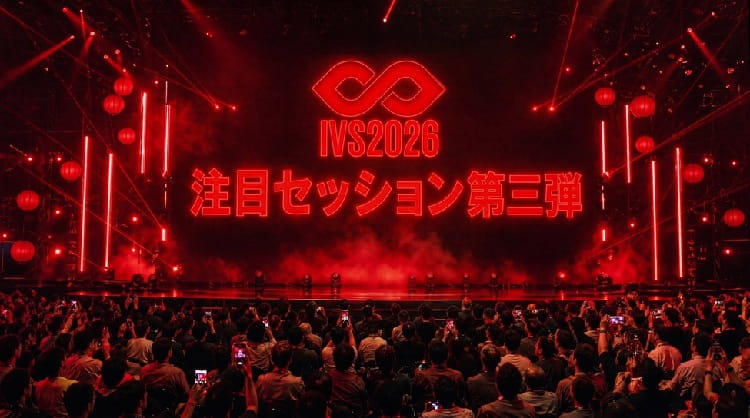
With “Japan is Back” as its theme, IVS Kyoto 2026 is being designed as more than a startup conference — it is a platform to connect Japanese founders with global capital, corporates and markets
KYOTO, Japan, June 29, 2026 – IVS Kyoto 2026 arrives at a significant moment for Japan’s startup ecosystem.
The country is seeking to create more globally competitive startups, attract international venture capital, commercialise deep technologies and help founders expand beyond the domestic market. At the same time, global investors and companies are reassessing Japan as a market with deep industrial capabilities, sophisticated customers, strong research institutions and renewed entrepreneurial energy.
Against this backdrop, IVS Kyoto 2026 will take place from July 1–3 under the theme “Japan is Back.”

Organised by the IVS KYOTO Executive Committee, comprising Headline Japan, Kyoto Prefecture and Kyoto City, the event will be held across venues including Kyoto Miyakomesse, Hotel Okura Kyoto and ROHM Theatre Kyoto. IVS describes the 2026 edition as one of Japan’s largest startup conferences, with more than 10,000 participants expected across the main IVS area and an invitation-only IVS CORE platform for decision-makers.
The official IVS2026 platform frames the ambition in direct terms: “Let’s prove Japan’s value to the world.” For a country that has long been associated with world-class corporations but a less globally visible startup ecosystem, that statement captures the challenge ahead.
Japan has deep strengths in manufacturing, robotics, materials, enterprise technology, gaming, precision engineering, healthcare and research. But its startup ecosystem has often remained less visible internationally than those of the United States, China, India or some Southeast Asian hubs.
IVS Kyoto 2026 is designed to narrow that visibility gap.
The event’s broader IVS area will include stage sessions, IVS Startup Market, networking platforms, side events, student-focused initiatives and IVS LAUNCHPAD. The Startup Market will bring together around 300 carefully selected Japanese and overseas startups, while LAUNCHPAD will give finalists six minutes to pitch before investors, entrepreneurs and business leaders.
IVS LAUNCHPAD has become one of the event’s flagship features. The official IVS website describes it as “a gateway for the next generation of entrepreneurs” and notes that its alumni have produced more than 60 exit companies and raised more than JPY 300 billion in total funding.
The 2026 edition also includes the Startup Kyoto International Award, under which the winner can receive up to JPY 10 million in support.
For startups, these platforms offer visibility. For investors, they offer deal flow. For corporates, they offer access to emerging technologies. For international participants, they provide a concentrated view of Japan’s startup pipeline.
The most important structural addition is IVS CORE.
Hosted at Hotel Okura Kyoto, IVS CORE is an invitation-only area for senior startup executives, investors, financial institutions, asset owners, corporate leaders, government and policy stakeholders, researchers and academia. Its purpose is not merely networking, but decision-making.
The official IVS2026 site describes IVS CORE as a forum where leading executives and investors gather to discuss key issues facing Japan’s startup ecosystem. It states that “what matters most is what gets decided.”
That distinction matters. Large startup events create energy and visibility. But capital allocation, corporate partnerships and policy-level discussions often require trusted, curated spaces where senior stakeholders can speak directly. IVS CORE appears designed to provide that layer.
In an AsiaBizToday interview, Whiplus Wang, who leads IVS Global, said the event’s role is to connect Japan’s startup ecosystem with international founders, investors and companies.
“Our role is to bridge these two communities,” Wang said. “We bring together the real players in the Japanese startup ecosystem and people from around the world.”
Wang also described the “Japan is Back” message as a call to global investors, startup founders and corporates to “come back to Japan and build here.”
That positioning reflects a two-way opportunity.
For international founders, Japan offers a large and sophisticated market, strong corporate customers, advanced manufacturing capabilities, research depth and potential partnerships in sectors such as AI, robotics, hardware, enterprise technology, climate technology and health.
For Japanese startups, internationalisation remains one of the central challenges. Many companies are built first for the domestic market, which is large enough to support substantial businesses. But startups with globally relevant technology often need to think about international hiring, product design, customer development and investor networks earlier in their journey.
IVS Global is attempting to support this shift by bringing international talent, investors and founders into Japan, while also taking Japanese startups into overseas ecosystems.
Wang told AsiaBizToday that IVS Global has previously taken around 30 companies to India, travelled to Africa and expanded its engagement across China, Hong Kong, Macau and Shenzhen. This suggests that IVS is not being positioned only as a three-day Kyoto event, but as a platform with year-round international intent.
Side events are another important part of this strategy.
The official IVS site says hundreds of side events take place throughout Kyoto and beyond, providing spaces where the conversations that begin during IVS can continue in more focused settings. It describes these events as places where the energy of wanting to talk more or do something together can be turned into action.
For international participants, this matters because Japan can be a relationship-driven market. Side events lower the barrier to entry by creating more informal routes into networks that might otherwise be difficult to access.
Kyoto itself strengthens the event’s positioning.
The city is globally recognised for its culture and history, but it is also an innovation hub with universities, research institutions, manufacturing companies, investors and public-sector support. Kyoto Startup Ecosystem describes the city as a network where universities, startups, global companies, investors and government collaborate to create the future.
That makes Kyoto more than a backdrop. It becomes part of the value proposition.
For founders from Singapore, India, Indonesia, Malaysia, Vietnam, Hong Kong and the wider Asia-Pacific region, IVS Kyoto 2026 can serve several purposes. They can explore Japan as a market, meet Japanese corporates, connect with venture investors, identify manufacturing partners or use Kyoto as a neutral meeting point to engage other Asian founders and funds.
For Japanese startups, the event can open doors to overseas capital, customers and expansion partners.
The real test for IVS Kyoto 2026 will be whether it can convert visibility into outcomes. Conferences can generate attention, but ecosystems are built through investments, partnerships, hiring, customer relationships and repeat engagement after the event ends.
IVS appears to be designing for that outcome. IVS CORE creates a decision-maker layer. Startup Market supports discovery. LAUNCHPAD creates a high-visibility pitch platform. Side events widen the network. Kyoto’s ecosystem provides academic, cultural and industrial depth. IVS Global extends the platform beyond Japan.
For ABT’s readers across Asia, IVS Kyoto 2026 should therefore be seen not only as a Japanese startup event, but as a signal of how Japan wants to re-enter the regional and global startup conversation.
“Japan is Back” may be the headline. But the deeper question is whether Japan can convert its industrial strengths, research excellence, corporate depth and renewed startup ambition into a globally connected ecosystem.
IVS Kyoto 2026 will be one of the clearest tests of that ambition.