

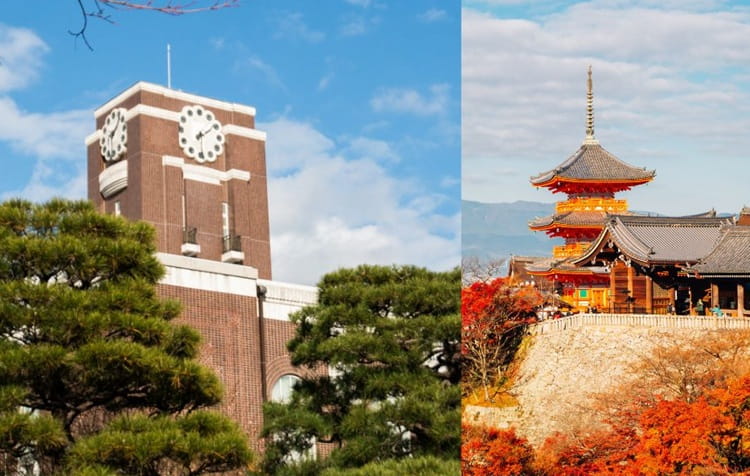
As IVS Kyoto 2026 approaches, the city’s academic ecosystem — led by Kyoto University and supported by capital, industry and government — is becoming central to Japan’s ambition to build globally competitive deep-tech startups
SINGAPORE, June 27, 2026 – If Kyoto’s corporate history explains why the city matters to Japan’s startup ecosystem, its university base explains why it could matter even more in the future.
Across Asia, governments and investors are asking a similar question: how can university research be converted into globally scalable companies? The question is especially important in deep tech, life sciences, artificial intelligence, robotics, materials, climate technology, semiconductors, healthcare and energy.
These sectors do not usually follow the fast-scaling playbook of consumer internet companies. They require scientific validation, intellectual property, laboratories, patient capital, corporate partners, regulatory understanding and specialised talent.

Kyoto is well placed in this conversation. The city is home to Kyoto University, one of Japan’s leading research institutions, and sits within a wider academic and industrial region that includes universities, manufacturing companies, research institutes and public-sector support bodies. Kyoto Startup Ecosystem’s official platform lists more than 40 universities, over 160,000 students and more than 37,000 researchers as part of the city’s innovation base.
This density of academic talent is not a background statistic. It is one of Kyoto’s most important startup assets. Deep-tech ecosystems rarely emerge from founders alone. They depend on research laboratories, technology-transfer pathways, venture investors, corporate customers, entrepreneurial training and people who can translate scientific work into commercial products. Kyoto’s current startup strategy is increasingly designed around that intersection.
Kyoto University Innovation Capital, or Kyoto iCAP, is one of the key institutions in this structure. Established in December 2014 with 100 per cent funding from Kyoto University, Kyoto iCAP invests in and supports companies that aim to commercialise research results and technologies from Kyoto University researchers.
In a CiRA/Kyoto University interview, Kono of Kyoto iCAP explained that one of the organisation’s defining features is that it can “support startups even before they are formally established.” That is particularly important in deep tech, where a venture may begin as a laboratory discovery long before it is ready to become a company.
The same CiRA interview highlighted the scale of Kyoto iCAP’s activity. Ueno of Kyoto iCAP said that over the past decade, the organisation had invested in 73 companies, nine of which had reached enterprise valuations exceeding JPY 10 billion. The interview also noted that around 80 per cent of Kyoto iCAP’s portfolio consists of seed and early-stage investments.
These details matter because early-stage deep-tech investing is difficult. Technologies are complex. Market applications may not be immediately obvious. Product development timelines can be long. Some companies require billions of yen before achieving meaningful commercial scale.
Private venture capital firms may hesitate to take such risks alone. University-linked funds such as Kyoto iCAP can help bridge that gap by identifying research early, supporting founders, recruiting executives, developing business plans and attracting co-investors.
The Keihanshin Startup Academia Coalition, or KSAC, adds another layer to Kyoto’s university-startup structure. Led by Kyoto University, KSAC brings together more than 60 organisations across the Kyoto-Osaka-Kobe region, including universities, companies, financial institutions and local governments.
Its stated aim is to create a virtuous cycle of people, research results and funding, while producing a steady stream of university-launched startups. In other words, it is trying to convert academic excellence into a repeatable company-building system.
This is the kind of ecosystem Japan needs if it wants to create more globally competitive startups in strategic sectors.
Japan already has deep strengths in manufacturing, materials, electronics, healthcare, robotics and scientific research. The challenge has often been commercialisation at venture speed. Research excellence does not automatically become startup success. It needs entrepreneurial teams, capital markets, customer access and international ambition.
Kyoto has many of the ingredients. It has universities. It has global industrial companies. It has a university-backed venture capital structure. It has ecosystem coordination through Kyoto Startup Ecosystem and KSAC. It has public-sector support. And now, through IVS Kyoto 2026, it has one of Japan’s most visible startup platforms bringing global investors and founders into the city.
Invest Kyoto describes the city’s startup ecosystem as one that supports entrepreneurs from training and commercialisation through to subsidies, fundraising, acceleration, market development and overseas expansion. It also identifies life sciences and deep tech as core fields.
For university-linked startups, this structure can be valuable. A researcher-founder may have strong technology but limited market access. A young deep-tech company may need corporate partners to test and validate a product. A life-sciences venture may need regulatory guidance, clinical networks and long-term funding. A materials or robotics company may need manufacturing partners and international customers.
IVS Kyoto 2026 can help bring those elements together. The event’s Startup Market will allow emerging companies to reach investors, corporates and media. IVS LAUNCHPAD will give selected startups a high-visibility pitch platform. IVS CORE will create a more closed environment for decision-makers, including investors, corporate leaders, government stakeholders, financial institutions, researchers and academia.
For university startups, this combination of public visibility and private deal-making can be powerful. It gives them a chance to tell their story, meet capital providers, identify partners and test international interest.
There is also a broader Asian relevance. Singapore, Bengaluru, Seoul, Taipei and Shenzhen are all trying to strengthen their university-to-startup pathways. Each ecosystem is asking how to support founder-scientists, attract venture capital into research-heavy sectors and build companies that can commercialise complex technologies across borders.
Kyoto’s model is not fully mature, but it offers a useful case study. It shows how a city with strong academic institutions, global manufacturing companies and public-private coordination can attempt to build a deep-tech startup platform.
The challenge now is scale. Kyoto must produce more companies capable of moving from laboratory discovery to international markets. It must attract talent beyond Japan. It must create stronger bridges between researchers and operators. It must bring more private capital into risky early stages. And it must help startups think globally earlier.
This is where IVS Kyoto 2026 could become more than an annual event. If the conference can help connect university startups with investors, customers, executives and overseas markets, it can become part of Kyoto’s commercialisation infrastructure.
The question is therefore not whether Kyoto has the research base to support deep-tech startups. It clearly does. The more important question is whether Kyoto can convert that research base into companies with global ambition.
As IVS Kyoto 2026 brings international investors, founders and corporations into the city, Kyoto has an opportunity to show that its universities are not only centres of academic excellence. They can also become engines of Japan’s next deep-tech wave.