

KYOTO, Japan, June 23, 2026 — IVS Kyoto 2026 is positioning itself as a defining platform for Japan’s startup ecosystem, with organisers using a joint press conference in Kyoto to underline the event’s growing international ambition, deeper collaboration with local government, and a renewed push to present Japanese startups to the world.
The IVS KYOTO Executive Committee, comprising Headline Japan, Kyoto Prefecture and Kyoto City, will host IVS2026 from July 1 to 3, 2026, across the Kyoto Municipal Kangyokan “Miyako Messe” and ROHM Theatre Kyoto. Ahead of the event, representatives of the three organising stakeholders came together at the Kyoto Prefectural Government Office to outline the event’s programme, strategic direction and key highlights.
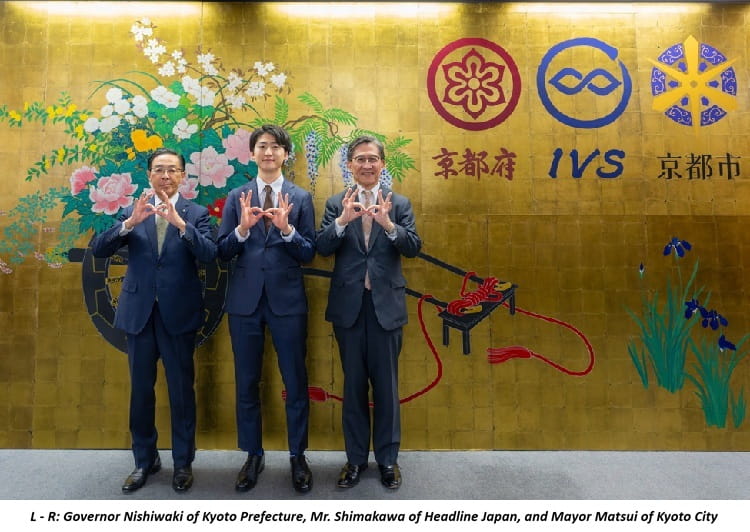
The press conference was attended by Toshiaki Shimakawa, Chairman of the IVS KYOTO Executive Committee and Representative Director of Headline Japan; Takatoshi Nishiwaki, Governor of Kyoto Prefecture; and Koji Matsui, Mayor of Kyoto City.
This year’s edition is being framed around the theme “Japan is Back”, a message that reflects IVS’s intention to demonstrate the renewed strength, competitiveness and global potential of Japan’s startup ecosystem.

“Japan is Back” and the global startup opportunity
For IVS2026, the theme goes beyond branding. It signals the event’s attempt to reposition Japan as a serious global startup destination at a time when international founders, investors and corporates are taking a fresh look at the country.
Shimakawa noted that IVS is entering its 20th year since the first edition and that IVS2026 will be the 33rd event overall. Kyoto will be hosting the event for the 11th time, and this will be the fourth consecutive year in which the conference is held in the city.
The scale of the 2026 edition reflects the broader ambition. IVS aims to bring together 10,000 attendees in the main IVS area and 1,000 participants in the invitation-only IVS CORE area. The organisers are targeting an international attendee ratio of 25 per cent, with participants from more than 70 countries and regions.
The objective is to create a platform that delivers both discovery and practical value for founders, investors, corporations and ecosystem builders. IVS2026 will combine networking, pitch competitions, startup showcases, curated discussions, side events and deeper decision-maker engagement.
The event’s organisers have made clear that IVS2026 is intended to prove the value of Japanese startups to the world while allowing Japan’s ecosystem to absorb global trends, capital, talent and entrepreneurial perspectives.
IVS CORE to create a private space for decision-makers
One of the major additions to the 2026 edition is IVS CORE, an invitation-only area for decision-makers. The new format has been designed as a closed environment for deeper and more intensive discussions among senior founders, investors, corporate leaders, policymakers and other key ecosystem participants.
Unlike the broader conference, IVS CORE will have strict rules prohibiting recording, filming and posting on social media. Sessions will be structured for 90 minutes, allowing participants to engage in more substantive conversations rather than short-form panel exchanges.
This approach reflects a wider shift in the way major startup conferences are being designed. Large gatherings need energy, visibility and scale, but high-value outcomes often depend on trusted spaces where senior stakeholders can speak openly and explore partnerships, investments and policy issues in greater depth.
For IVS2026, the combination of the open IVS area and the more curated IVS CORE platform is intended to serve different participant needs within one event ecosystem.
Startup Market to feature more than 300 companies
A major focus of IVS2026 will be the IVS Startup Market, which will feature more than 300 exhibiting companies. The Startup Market is intended to give promising startups greater visibility among domestic and international investors, corporates, media, potential partners and customers. It also supports the event’s broader goal of positioning Japan as a source of investable and globally relevant innovation.
For international participants, the Startup Market will offer a concentrated view of the breadth of Japan’s emerging companies across sectors, while also enabling startups from outside Japan to explore market entry and collaboration opportunities.
This becomes particularly important in the context of Japan’s deep strengths in areas such as manufacturing, robotics, enterprise technology, materials, AI, climate technology, healthcare and deep tech. While Japanese corporations are globally recognised, its startup ecosystem has not always received the same level of international visibility.
IVS2026 appears designed to change that by creating a structured marketplace for discovery, investment and partnership.
LAUNCHPAD finalists highlight depth and diversity of innovation
The press conference also included the announcement of the 15 finalist companies selected for IVS2026 LAUNCHPAD, one of Japan’s largest pitch events and a flagship component of IVS.
The finalists were selected from more than 500 applications, with approximately 20 per cent of applications coming from overseas companies. The selected startups will pitch at the ROHM Theatre Kyoto Main Hall on July 3, 2026.
Each finalist will present its product and business vision in a six-minute pitch before judges comprising investors, business executives and entrepreneurs. The winner will receive the Startup Kyoto International Award, along with a runner-up prize of 10 million yen in business support funds.
The finalist list includes companies across IT, deep tech and globally oriented business models. The presence of a record number of overseas finalists also points to LAUNCHPAD’s evolution from a primarily Japanese startup stage into a platform for companies seeking to enter or expand in the Japanese market.
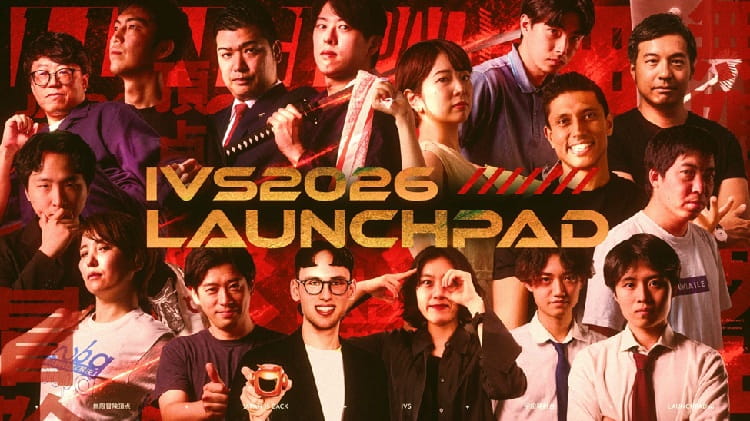
The 15 finalists announced for IVS2026 LAUNCHPAD are:
AKARI Guarantee Co., Ltd.; inprog Inc.; UMIAILE Co., Ltd.; Elith, Inc.; Satelyx; zooba, Inc.; Space Quarters Co., Ltd.; ZetaX Co., Ltd.; TAIAN Co., Ltd.; tamateco Co., Ltd.; Tofuchan; HiStranger; MUSE Co., Ltd.; Ryp Labs; and Robotrack Co., Ltd.
The diversity of the finalist pool underlines IVS’s attempt to broaden the scope of Japan’s startup conversation beyond software and consumer internet to include deep tech, global expansion and emerging sectors.
Referral tickets and the IVS Family Tree
Another new feature announced for IVS2026 is the referral ticket system.
The system is intended to create a chain of introductions, where receiving an introduction leads to participation, and participation can in turn lead to new introductions. Through the “IVS Family Tree”, participants will be able to visualise the network of connections that brought people into the conference.
This reflects a central idea behind IVS: that startup ecosystems are built not only through content and exhibitions, but through trust-based networks.
For founders, the right introduction can lead to capital, customers, mentors or market access. For investors, referrals can improve deal flow and help identify founders with credible networks. For corporates, trusted connections can reduce the friction involved in engaging emerging companies.
By formalising this network effect through its ticketing and referral system, IVS2026 is attempting to turn participation itself into a relationship-building mechanism.
Side events to turn Kyoto into a city-wide startup platform
Side events have become an increasingly important part of IVS, and the organisers are placing further emphasis on them in 2026.
These events are hosted by IVS participants before, during and after the main conference. They allow founders, investors, corporations, universities, community builders and other stakeholders to create more targeted formats around specific themes, industries or communities.
For 2026, IVS will introduce an IVS Certified Official Badge for approved side events that meet its operational standards. Certified events will be listed on the 4S ticket platform, improving discoverability and coordination.
Official side events will, in principle, require an IVS ticket, a move designed to strengthen the connection between the main conference and the wider event ecosystem.
This approach is important because large conferences increasingly function as anchor events around which entire city-level innovation weeks are built. The main venue provides scale and visibility, while side events create more specialised and informal spaces for deeper conversations.
In Kyoto, this model allows the city itself to become part of the startup experience.
Kyoto’s role as a deep tech and innovation hub
Kyoto Prefecture and Kyoto City are not merely host locations for IVS2026. They are positioning themselves as active ecosystem partners.
Governor Nishiwaki said the event has contributed to Kyoto’s recognition as a place of encounter for startups. He also noted that IVS does not end when the conference closes, pointing to collaborations that have continued between past LAUNCHPAD-winning companies and universities or companies in the prefecture.
This reflects a more long-term view of startup events as ecosystem infrastructure rather than temporary gatherings.
The prefecture will also feature the KYOTO ZONE, a space bringing together representative companies, universities, financial institutions and other ecosystem players. The objective is to enable participants to experience Kyoto’s startup ecosystem directly while discussing business challenges, technologies and market needs with local and international startups.
Kyoto Prefecture aims to present itself as a deep tech hub where talent, capital and technology can come together to generate globally competitive startups.
That positioning is consistent with Kyoto’s broader economic identity. The region is home to major technology and manufacturing companies, strong universities, research institutions and a distinctive cultural heritage that supports design, craftsmanship and long-term thinking.
Kyoto City links innovation with culture and social value
Mayor Matsui emphasised the role of side events in connecting IVS participants with Kyoto’s companies, culture and people.
Among the notable official side events hosted by Kyoto City are “NATURE POSITIVE NIGHT: Tasting Kyoto’s Natural Capital and Zebra Management through the Five Senses” on July 1, and “Intersection of Tradition and Innovation: Business Succession Innovation meet up 2026 starting from Kyoto” on July 3.
These themes reflect Kyoto’s attempt to connect innovation with natural capital, sustainability, cultural continuity and business succession.
Matsui described Kyoto through the metaphor of “Nukadoko”, a fermented rice bran bed that continually incorporates new elements while building on a long history and culture. The image captures the city’s effort to blend tradition and innovation rather than present them as opposing forces.
For IVS participants, this means Kyoto is not simply a backdrop. It becomes a living context in which startups, researchers, manufacturers, cultural institutions and civic leaders can interact.
IVS2026 and Japan’s startup moment
The significance of IVS2026 lies in the convergence of several forces. Japan is seeking to strengthen its startup ecosystem, attract international capital, commercialise deep technologies, create globally competitive companies and build stronger connections with founders and investors across Asia and the world.
At the same time, Kyoto is using IVS as a platform to showcase its own innovation assets, including universities, deep tech capabilities, companies, financial institutions, cultural resources and sustainability-oriented initiatives.
For overseas investors and founders, IVS2026 offers a concentrated opportunity to understand Japan’s startup environment and identify partners. For Japanese startups, it provides visibility, capital access and global market exposure.
The announcement of IVS CORE, the expanded Startup Market, the LAUNCHPAD finalist lineup, certified side events and Kyoto’s ecosystem initiatives suggests that IVS2026 is being designed not only as a conference, but as a startup platform with multiple layers of engagement.
The theme “Japan is Back” captures this ambition. The real test will be whether IVS2026 can translate visibility into outcomes: investments, partnerships, customer relationships, international expansion and sustained ecosystem activity beyond the three days in Kyoto.
For Japan’s startup ecosystem, IVS Kyoto 2026 may serve as both a showcase and a signal — that the country wants to be seen not only as a market of established corporations, but as a serious global destination for founders, capital and innovation.