
MACAU, June 4, 2026 – When Dr. Gang Lu first conceived BEYOND Expo in 2019, the objective was straightforward but ambitious: create a platform that could showcase Asia’s rapidly evolving innovation ecosystem to the world.
Six editions later, BEYOND Expo has emerged as one of the region’s most influential technology gatherings, attracting startups, investors, corporates, policymakers and media from across Asia and beyond. Yet according to Lu, Founder and CEO of TechNode Group, Co-Founder of BEYOND Expo and Chairman of the Macao Technology General Association, the journey is only just beginning.
Speaking to AsiaBizToday on the sidelines of BEYOND Expo 2026 in Macao, Lu reflected on the origins of the event, the rise of Asia as a global innovation powerhouse, the transformative impact of artificial intelligence and his vision for turning BEYOND into a truly international innovation ecosystem.
Filling a Missing Gap in Asia’s Innovation Landscape
The idea for BEYOND Expo was born from a simple observation. While Asia was becoming an increasingly important source of technological innovation, the world’s most recognised technology gatherings remained concentrated in North America and Europe.
“If you look at all the big tech events, CES in Las Vegas, VivaTech in France, Mobile World Congress in Barcelona, none of them are really happening in Asia,” Lu said.
Yet the region was rapidly becoming the epicentre of global innovation.
“We see more and more technology innovation coming from Asia, from China, Japan, Korea, India and Southeast Asia. There is huge market potential here, but there wasn’t one platform that could bring everyone together.”
Creating such a platform, however, was easier said than done. Unlike the relatively integrated markets of North America or Europe, Asia remains fragmented by language, culture, regulations and business practices.
“The Asian market is actually quite fragmented. There are language barriers and cultural differences. To bring everyone together is really hard work,” Lu noted.
Despite these challenges, Lu believed the region needed a common stage where innovators, founders and investors could exchange ideas, showcase technologies and build partnerships. “Our goal was to create a platform that could showcase the best of Asia.”
Beyond Products, Telling the Stories of Asian Founders
One of BEYOND Expo’s defining characteristics is its emphasis on entrepreneurs and their stories rather than simply displaying products. While global events such as CES are known for unveiling new technologies, Lu believes Asia’s innovation ecosystem deserves a platform that highlights the people behind the innovations.
“We don’t want to replace CES,” he said. “CES is a must-attend global event and has been running successfully for many years.” Instead, BEYOND seeks to complement such events by offering something different.
“What we want to do is help people not only see the products, but also meet the founders and understand their stories.” According to Lu, many of Asia’s most innovative startups lack the resources to travel to major global events or attract international media attention.
As a result, groundbreaking technologies and entrepreneurial journeys often remain underrepresented on the global stage. “There are so many fascinating founder stories in Asia. There is so much innovation and truly innovative thinking happening here, but many people still don’t know about them.”
By bringing together international media, investors and founders in one place, BEYOND aims to bridge that visibility gap.
AI’s Journey from Digital to Physical
The theme of BEYOND Expo 2026, “AI: Digital to Physical,” reflects what Lu believes will be one of the defining technological shifts of the coming decade.
While software-based AI applications have captured global attention, he sees Asia’s real advantage emerging in the physical implementation of AI through robotics, smart devices and intelligent hardware. “I think AI is going to dominate everything,” he said.
The Greater Bay Area, which encompasses Hong Kong, Macau and Shenzhen, is particularly well positioned to lead this transition. As one of the world’s most important manufacturing and technology clusters, the region combines advanced hardware capabilities with rapidly evolving AI expertise.
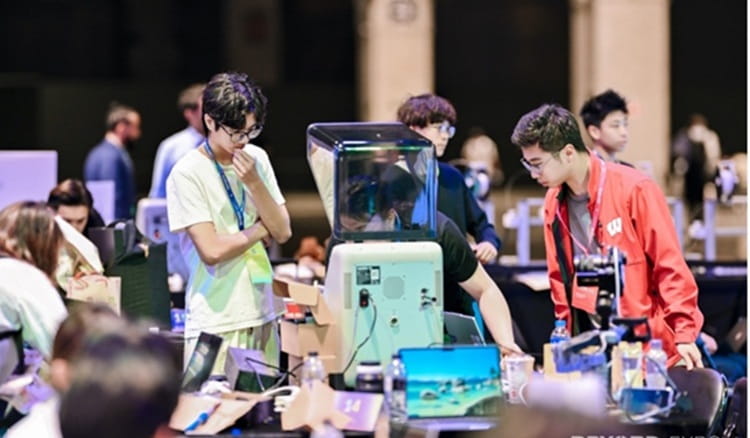
“As you can see here, there are so many robots,” Lu said, gesturing across the exhibition floor. Yet he believes the industry still has significant work to do before robotics become mainstream.
“It’s good to see robots dancing and fighting, but we need robots that are more usable. We need robots that can do real work for consumers.” For Lu, the next wave of AI innovation will be measured not by novelty, but by practical applications that improve everyday life.
Building an Ecosystem, Not Just an Event
A defining feature of BEYOND Expo is the diversity of participants it attracts. Startups share exhibition space with multinational corporations. Venture capital firms engage with entrepreneurs. Policymakers participate alongside academics and researchers.
Lu argues that this ecosystem approach is essential for innovation to thrive. “Startups need all kinds of support,” he explained. “They need policy support, funding, media visibility and access to markets.”
This is particularly true for emerging sectors such as artificial intelligence, robotics and climate technology, where regulatory frameworks, capital requirements and public understanding all play critical roles.
By bringing together stakeholders from across the innovation ecosystem, BEYOND seeks to accelerate both innovation and commercialisation.
“We want all these different parts of the ecosystem to work together.”
Technology Must Serve Society
As climate technologies, smart mobility solutions and sustainable innovations become increasingly visible at BEYOND Expo, Lu believes technology companies must remain focused on broader societal outcomes.
“Hardware alone is just hardware,” he said. “Technology needs to be used to improve society.” This philosophy underpins BEYOND’s growing emphasis on sustainability and social impact.
Whether discussing AI, robotics or climate innovation, Lu repeatedly returns to a simple principle: technology should make life better for people. “I really like the phrase ‘AI for Good’,” he said. “Whatever we build, whether it is software, hardware or robots, it should help people and contribute to a healthier world.”
At a time of growing geopolitical tensions, trade restrictions and technological competition, Lu believes platforms such as BEYOND Expo have an important role to play in maintaining dialogue and collaboration.
“We strongly believe technology should be independent from geopolitical issues,” he said. For him, innovation remains a global endeavour that transcends political boundaries.
“Business is business. We want to build a platform where people can work together and create opportunities.”
The internationalisation of BEYOND Expo remains a major priority. This year’s event attracted delegations from Japan, South Korea, Brazil and the Middle East, reflecting the growing global interest in Asia’s technology ecosystem.
However, Lu acknowledges that there is still work to be done. “We want to see more participation from South Asia. We still need more companies from India, for example.”
Beyond Macau
Looking ahead, Lu envisions BEYOND evolving from a single annual event into a broader global innovation platform. Macau will remain its flagship gathering, but the organisation is exploring opportunities to extend the ecosystem into other regions.
“Maybe every year Macau can host the biggest BEYOND gathering,” he said. “But perhaps we can also organise smaller events in South Asia, the Middle East and other regions.”
The ambition reflects the broader mission that inspired BEYOND’s creation in the first place: connecting innovators, entrepreneurs and investors across borders.
Asked about the technological shifts that will most profoundly impact society over the next decade, Lu did not hesitate. “Definitely AI.”
He pointed to education as one of the first sectors already undergoing transformation. In China, children as young as six or seven are using AI tools such as DeepSeek to support their studies, fundamentally changing how they learn and access information.
At BEYOND Expo’s hackathon this year, one of the participants was just nine years old. “The youngest hacker was only nine years old,” Lu said. “And I heard he even received a job offer.”
For Lu, this is only the beginning. He described emerging technologies capable of translating human speech into animal communication as an example of how AI could eventually reshape entirely new forms of interaction.
“It sounds like science fiction, but I have seen demonstrations,” he said. “Maybe one day we will be able to talk to our dogs.” Whether through education, robotics, climate innovation or entirely new forms of communication, Lu believes artificial intelligence will redefine how people live, learn and interact.
And if his vision for BEYOND Expo succeeds, Asia will play a leading role in shaping that future. “Asia has so many innovative founders and companies,” he said. “Our mission is to help the world discover them.”