
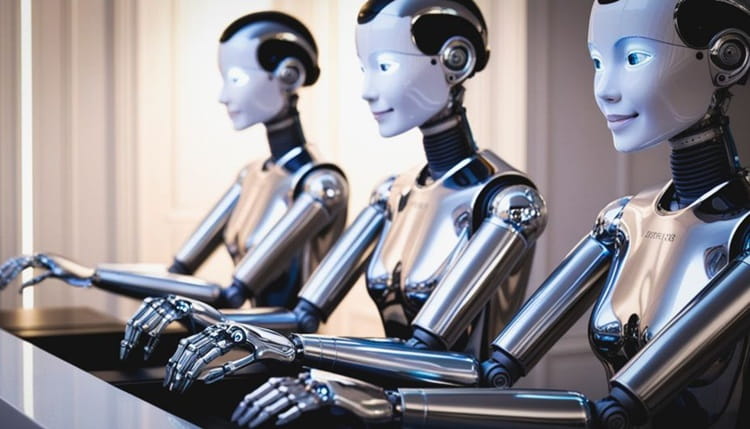
Japan’s robotics sector is charging into a future where machines bridge the nation’s acute labour gaps, blending cutting-edge AI with hardware prowess to power factories, homes, and disaster zones.
At the forthcoming SusHi Tech Tokyo 2026, Japan’s robotics sector will showcase prototypes hinted at the government’s 2027 mass-production goal for humanoid robots, targeting a market worth trillions of yen as demographics demand smarter automation.
Japan faces a workforce crisis, with over 10 million jobs unfilled by 2030 due to a shrinking population. The Ministry of Economy, Trade and Industry (METI) unveiled its 2025 Robotics Strategy, pledging ¥500 billion in subsidies for humanoid development, focusing on “Physical AI” that mimics human dexterity and decision-making. Prototypes dazzle: 250cm-tall giants for disaster response lift 50kg payloads in rubble, while human-sized units navigate stairs with gymnast-like agility.
METI’s strategy, as outlined in updates, positions robotics to transform productivity amid shortages, targeting embodied AI leadership. This push fuses sensors, generative AI, and actuators, aiming to deploy 100,000 units annually by decade’s end.

Real-Time Robotics leads with its Rapid Plan software, slashing industrial arm programming from days to minutes via AI collision avoidance. In automotive plants, where Toyota and Honda grapple with 20% vacancy rates, the platform enables cobots to adapt on-the-fly to part variations. CEO Peter Kazanzides emphasized in Robotics Business Review, “Our AI democratizes robotics—workers focus on strategy, not code, boosting throughput by 40%.” Partnerships with Fanuc and Yaskawa target electric vehicle assembly, where precision welding demands human-like improvisation.
Fanuc’s latest CRX series integrates such AI, handling mixed loads from screws to engines without reconfiguration. Deployments at Mazda plants cut downtime 30%, proving software’s role in scaling amid a 1.3 million manufacturing shortfall.
Electronics behemoths form the Robot Alliance Japan, pooling R&D for open-source Physical AI frameworks. Sony, Panasonic, and NEC contribute vision systems and edge computing, birthing bots that learn from video demos. Donut Robotics’ Grace series, emotional companions for elderly care, uses NLP for conversation, with 5,000 units in nursing homes easing caregiver burdens.
Alliance head Hiroshi Yamamoto told Japan Times, “Collaboration accelerates ‘human augmentation’—robots as partners, not replacements, leveraging Japan’s sensor supremacy.” Funding pours in: SoftBank Vision Fund’s ¥200 billion arm backs unicorns like Preferred Networks, whose AI brains power 80% of humanoid cognition.
Figure AI’s Japan arm, backed by ¥100 billion from Mitsui, unveils 1.8m bipeds for warehouses, sprinting at 5m/s with 20kg lifts. TDK’s actuators enable fluid motion, inspired by biological muscles. Disaster bots from Chiba Institute shine: oil-dampened joints withstand quakes, deploying via drones for Fukushima-like ops.
Venture capital hit ¥1.2 trillion in 2025, up 35%, crowning robotics Japan’s top sector. Goldman Sachs predicts 20% CAGR to ¥10 trillion by 2030, driven by exports to aging Asia. Mitsubishi UFJ leads with ¥300 billion for grippers and batteries, while government bonds fund METI’s Robot Valley in Fukuoka—1,000 startups by 2028.
iREX 2025 drew 50,000 attendees, showcasing 500 exhibitors. Venture capitalist Hiroshi Aoki noted in Forbes Japan, “Demographics are our rocket fuel—investors bet on robots solving eldercare and reskilling, not displacing jobs.” Overseas, Tesla’s Optimus inspires but trails Japan’s edge in miniaturization.
Challenges persist: battery life lags at 4 hours for heavy lifts, and AI ethics debates rage over job displacement. Safety regs demand “predictable autonomy,” delaying approvals. Talent wars intensify, with 50,000 engineers needed yearly—universities like Tokyo Tech pivot to robotics PhDs.
Yet resilience defines: post-2024 typhoon trials validated bots in flood rescues, saving 200 lives. Standardization efforts by JARA (Japan Robotics Association) harmonize interfaces, cutting integration costs 50%. However, Woven Capital’s Ro Gupta told TechCrunch, “Physical AI is being bought as a continuity tool: How do you keep factories, warehouses, infrastructure, and service operations running with fewer people?”
These visions underscore METI’s ¥500 billion push for embodied intelligence amid a workforce projected to shrink by 15 million. Hyundai’s Boston Dynamics has recently bought TDK actuators for Atlas upgrades, while EU’s Horizon Europe grants ¥50 billion for joint humanoids. NASA taps Fanuc for Artemis habitats, blending robotics with space tech from ispace kin.
U.S. firms like Boston Dynamics demo alongside locals, fostering IP swaps. NEC’s edge AI powers Singapore’s elder bots, exporting ¥200 billion yearly.
By 2030s, humanoids permeate factory floors that hum with teams of man-machine, Homes will host companions staving off loneliness epidemics, and disaster zones deploy swarms. The ¥10 trillion sector promises 2 million jobs in design and maintenance, redefining prosperity.
From assembly lines to elder arms, this revolution cements the archipelago as the world’s robotics forge, turning demographic destiny into digital dynasty.