
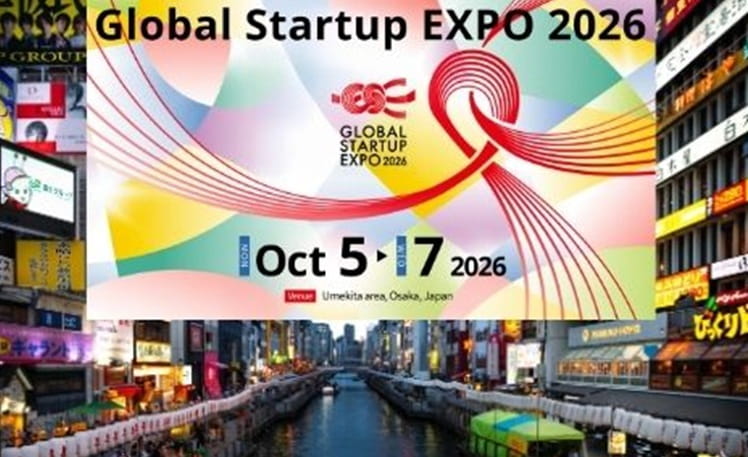
OSAKA, JAPAN, August 30, 2026 — Japan is preparing to bring some of the world’s leading startups, venture investors, corporates, researchers and policymakers together in Osaka this October as Global Startup EXPO 2026 (GSE2026) returns with an expanded focus on converting deeptech breakthroughs into commercially viable industries.
Scheduled to take place from October 5–7, 2026, GSE2026 will be held across venues in Osaka’s Nakanoshima and Umeda-Kita areas, with a three-day programme spanning startup exhibitions, investment and business matching, conference sessions, side events and a major international deeptech pitch competition.
Under the theme “Deeptech — from breakthrough to industry,” the event is positioning itself as more than a conventional startup conference. Its emphasis this year is on moving emerging technologies beyond laboratories and demonstration projects towards commercial deployment, industrial collaboration and international scale.
The focus is particularly relevant as governments and investors increasingly look towards deeptech to address challenges ranging from healthcare and energy security to artificial intelligence, advanced manufacturing and next-generation communications.
Six technology sectors take centre stage
GSE2026 will centre much of its programme around six strategic technology domains: biotechnology and healthcare, quantum technology, fusion energy, space, AI and advanced robotics, and semiconductors and telecommunications. These areas sit within the wider strategic industries being prioritised under Japan’s national growth agenda.
The selection gives the Expo a distinctly industrial orientation. Rather than concentrating solely on early-stage startup ideas, GSE2026 is intended to bring emerging companies into contact with manufacturers, large corporations, universities, investors and public-sector stakeholders capable of helping technologies progress towards proof-of-concept projects, commercial partnerships and eventual deployment.
This is particularly significant in Kansai, one of Japan’s major industrial and research regions. Osaka, Kyoto and Kobe collectively host a dense concentration of universities, advanced manufacturers, healthcare institutions and technology companies, giving startups access to both research capabilities and potential industrial partners.
According to the organisers, the Expo aims to connect deeptech with “business” and “industry” as Japan advances a growth strategy envisaging approximately JPY 370 trillion in public-private investment by 2040.
From discovery to business matching
The GSE2026 format has been organised around three broad stages — Discover, Engage and Build. Conference sessions and startup competitions will provide the discovery element, while exhibitions and side events are intended to facilitate engagement across the ecosystem. The final component places particular emphasis on curated business and investment matching.
The matching programme is expected to connect startups with corporations, Japanese manufacturers and venture capital investors across the six core technology areas.
For overseas startups in particular, this could offer an entry point into Japan’s extensive manufacturing ecosystem. Osaka and the broader Kansai region are home to numerous established industrial companies, creating opportunities for startups seeking engineering partners, pilot projects, manufacturing relationships and customers.
GSE2026 plans to facilitate encounters between startups and manufacturers that could potentially lead to prototyping, proof-of-concept projects and joint development.
For Japanese companies, the proposition works in the opposite direction: the Expo offers an opportunity to identify emerging technologies and startup partners internationally.
Global investors and technology leaders on the speaker roster
A growing roster of international investors, entrepreneurs, technology executives and researchers has already been announced for GSE2026.
Among the speakers are Christine Tsai, CEO and Founding Partner of 500 Global; Caroline Winnett, Executive Director of Berkeley SkyDeck; Andrew Schoen of New Enterprise Associates (NEA); Eric Benhamou of Benhamou Global Ventures; Laurent Rains of Alchemist Accelerator; and Karthee Madasamy, Founding Managing Partner of MFV Partners.
The programme also brings together prominent figures from Japan’s research and technology ecosystem.
These include Akira Yoshino, Honorary Fellow at Asahi Kasei and winner of the 2019 Nobel Prize in Chemistry for his role in the development of the lithium-ion battery; Hiroshi Amano, Distinguished Professor at Nagoya University and a Nobel laureate in Physics; and Shimon Sakaguchi, Distinguished Honorary Professor at the University of Osaka.
Other speakers announced include technology entrepreneurs, venture capitalists and ecosystem leaders working across AI, quantum technology, fusion, climate technology and startup development.
The diversity of the speaker pool reinforces GSE2026’s attempt to bridge research, venture capital and industrial execution rather than treating them as separate parts of the innovation ecosystem.
JPY 10 million prize for deeptech startups
One of the focal points of the Expo will be the DeepTech Frontier Challenge 2026, an international startup pitch competition carrying a JPY 10 million grand prize.
The competition is targeting seed- to mid-stage companies developing R&D-led technologies in areas including AI and advanced robotics, semiconductors and communications, quantum technology, biotechnology and healthcare, space and fusion energy. Participating startups are also expected to demonstrate ambitions for international expansion.
Around 30 companies were expected to progress through the first screening stage, with approximately 15 advancing towards the final selection process. The final pitch competition is scheduled for October 6 at the Knowledge Theater in Grand Front Osaka.
Importantly, the pitch programme is structured not simply around identifying technological novelty.
Companies are being evaluated on technological innovation, marketability and international expansion potential, social impact, business models and growth strategies — reflecting the Expo’s broader commercialisation theme.
The organisers also intend for participation to create connections leading to fundraising, business collaborations and demonstration opportunities.
Life sciences open the three-day programme
GSE2026 will begin on October 5 with an Opening & Life Science Day in Osaka’s Nakanoshima area. The programme will bring together medical institutions, startups, academia, companies and investors around next-generation healthcare and medical innovation.
Kansai already has significant strengths in fields such as regenerative medicine, biomedical research and pharmaceutical development, alongside infrastructure supporting cell cultivation and manufacturing. The opening day is therefore designed to link the region’s research capabilities more closely with startup creation and commercial deployment.
The main Expo Days on October 6 and 7 will subsequently broaden the programme across all six deeptech sectors, with startup booths, conference sessions, business meetings and investment activity concentrated around Grand Front Osaka and Grand Green Osaka.
Building on more than 10,000 participants in 2025
The 2026 edition builds on the inaugural Global Startup EXPO held during the broader momentum surrounding Expo 2025 Osaka, Kansai.
According to figures published by the organisers, more than 10,000 startup-related participants attended GSE2025 over two days, with approximately 150 Japanese and international startups exhibiting. The programme included 37 conference sessions and around 50 side events.
The follow-on edition indicates an effort by Osaka and the Kansai region to convert the international visibility generated around Expo 2025 into a more permanent innovation and investment platform.
That distinction could ultimately determine the significance of GSE. Large startup gatherings have become common across Asia, but deeptech companies typically need far more than visibility. They require patient capital, access to laboratories and engineering expertise, regulatory support, corporate customers and manufacturing capacity.
By bringing these stakeholders into a common platform, GSE2026 is attempting to address precisely that gap between scientific innovation and industrial scale.
Japan strengthens its global startup proposition
The event also comes as Japan attempts to strengthen its position within the global startup economy and attract more international founders and investors.
For startups from markets such as Southeast Asia and India, Japan can offer access to sophisticated corporate customers, engineering talent, advanced manufacturing supply chains and substantial pools of capital. At the same time, navigating the Japanese market can remain challenging without local networks and corporate relationships.
Platforms such as GSE2026 can therefore play an important bridging role, particularly if structured business matching translates conference participation into tangible partnerships.
The event is being organised by the Global Startup EXPO 2026 Executive Committee, whose members include the Osaka, Kyoto and Hyogo prefectural and city governments, the Kansai Economic Federation, Osaka Chamber of Commerce and Industry, Osaka Business Development Agency and other regional organisations.
It is being co-organised by bodies including Japan’s Ministry of Economy, Trade and Industry (METI), JETRO and NEDO.
With global capital increasingly seeking technologies capable of addressing structural problems in healthcare, energy, computing and industrial productivity, Osaka’s latest startup gathering is making a clear proposition: the next phase of the deeptech race will not simply be about who invents the technology, but who can turn it into an industry.