

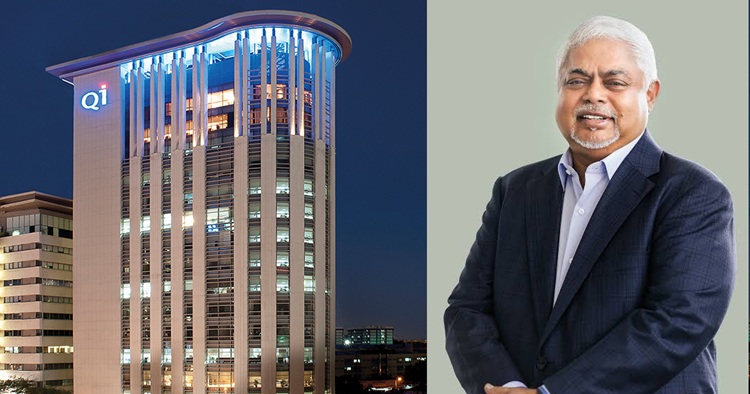
SINGAPORE, September 15, 2026 – Asia’s next phase of growth will be shaped not only by technology and capital, but by a return to entrepreneurship, resilient leadership and the ability of businesses to keep people at the centre of change, according to Vijay Eswaran, Founder and Executive Chairman of QI Group.
Speaking to AsiaBizToday for the Asia Insights series, Eswaran said Asia’s economic rise has been built on trade, enterprise and adaptability, qualities that are becoming newly relevant as e-commerce, direct selling, the gig economy and artificial intelligence reshape the way companies are built and led.
For Eswaran, the future of Asia is not a break from its past. It is, in many ways, a rediscovery of its entrepreneurial roots.
He traced that view back to his own decision to return to Asia after years of studying and working overseas. Having worked in the Bay Area at a time when e-commerce was beginning to emerge, he saw early signs of how digital commerce could transform business. But after spending 13 years away, including study in the United Kingdom and work postings with IBM in Canada, Australia and New Zealand, he found that Asia had changed dramatically.
Hong Kong, in particular, shifted his perception of what Asia could become. “This was the place to be,” he said, describing that moment as the beginning of the “Asian millennium”.
He also saw fewer barriers in Asia than in the United States, where he said the corporate “glass ceiling” was inevitable for him at that stage of his career.
Building an Asian E-commerce and Direct Sales Model
QI Group began in 1998, when global e-commerce models were just taking shape. Eswaran said his initial vision was to build an e-commerce platform, drawing inspiration from companies such as eBay, Amazon and Alibaba, which were all emerging around the same period.
But the model that developed was not e-commerce alone. From the beginning, Eswaran believed entrepreneurship had to be part of the platform. QI Group combined online commerce with a direct sales component, a combination he said became a winning formula.
That approach reflected his belief that direct selling was not merely a distribution channel, but a way of putting entrepreneurship back into the hands of individuals.
Over time, QI Group expanded into multiple sectors through what Eswaran described as backward integration. Initially, the group provided products through its platform and direct sales network. It then recognised that it was not participating enough in the backend, including manufacturing, product development and ownership.
Education has become one of the areas that Eswaran is personally most engaged with. He said QI Group’s entry into education began with an interest in online learning. When a university licence became available in Malaysia, the group saw it as an investment that could provide a foundation for online education. But the university, he said, “took a life of itself”.
Today, he said, the university has 2,500 students, and he was preparing to attend the groundbreaking of a new campus in Ipoh.
Entrepreneurship as Asia’s Original Growth Engine
Eswaran said the current rise of the gig economy and digital entrepreneurship should not be seen as entirely new. In Asia, he argued, entrepreneurship has always been embedded in economic life.
He said that five generations ago, most people in Asia were not conventional nine-to-five employees. They were farmers, traders, craftsmen or people with vocations, often inheriting skills from their parents.
For him, the modern conversation around entrepreneurship is therefore a return to a much older pattern of work and enterprise.
Direct sales, he argued, brings entrepreneurship back into business by reducing the monopoly that large corporations have historically held over sales. While he does not believe malls and department stores will disappear completely, he said the time has come for entrepreneurship to regain a central role.
He also placed Southeast Asia’s history within this commercial frame, noting that European powers came to the region in search of spices, at a time when spice was more valuable than gold. The Portuguese, Dutch and British, he said, all came in search of trade.
Leadership in a Disrupted Economy
Eswaran said the future of business leadership will depend less on hierarchy and more on people skills, care and purpose.
Asked what distinguishes successful leaders from successful managers, he answered: “People skills.” He said a leader who cannot establish care for the people they work with is not really leading, but merely fulfilling a role.
Purpose-driven leadership, he said, has become essential for companies trying to survive recurring disruption. He pointed to the Asian financial crisis, the bursting of the internet bubble, the pandemic and other regional and global economic challenges as examples of shocks that companies have had to withstand.
To survive such disruption, companies need resilience. That resilience comes from building a culture where people recognise they are part of something meaningful. His core leadership message is direct: “Companies don’t succeed. People do.”
Rethinking Human Connection in the Digital Workplace
Eswaran also challenged the idea that younger generations are losing human connection because they communicate differently. His point was that communication has changed form. Young people may sit at the same table without speaking in the way older generations expect, but they remain engaged through phones, platforms and networks.
He described this as another evolution in communication, comparable to earlier shifts brought about by the telegraph and telephone. For companies, the implication is that leaders must adapt to new modes of communication rather than assume that human connection has disappeared.
AI Is No Longer a Future Issue
Eswaran said artificial intelligence is no longer something businesses should think of as coming in the future. It is already here. He said discussions at the World Economic Forum had moved over recent years from the arrival of AI, to how societies should adjust to it, and then to AI’s legacy. “AI is now not a subject about anticipation. It’s here,” he said.
He contrasted Western fears of AI, shaped in part by films such as Terminator, Resident Evil and The Matrix, with what he described as a more accepting Eastern view of technology.
He recalled a conversation with a Japanese artist at the World Economic Forum who argued that in the East, particularly in Japan, Taiwan and China, AI is not always viewed as an enemy. Eswaran linked this to the way Japanese culture can perceive spirit or energy in natural objects and places, suggesting that AI may similarly be treated as something with energy and presence rather than as a hostile force.
For Eswaran, the practical response to AI is to adapt, adjust and accommodate. Younger generations, he said, are already doing this more comfortably than older ones. Eswaran does not dismiss concerns about AI’s impact on employment. But he said jobs will evolve, not disappear altogether.
He compared AI with earlier technological breakthroughs, including the Industrial Revolution, arguing that every major technological change has eliminated one set of employment while creating new realities of work. “The future of jobs will be different in 10 years. 100%,” he said.
Asia’s Next Business Chapter
Eswaran’s conversation points to a broader argument about Asia’s future.
The region’s next growth phase will not be defined only by digital platforms, AI tools, investment flows or consumer markets. It will also depend on whether businesses can revive entrepreneurship, build resilient cultures, adapt to technology and preserve the human relationships that make organisations endure.
QI Group’s own journey mirrors that arc. It began as an e-commerce and direct sales platform at the start of the internet economy, expanded through product ownership and backward integration, and has moved into sectors such as wellness, watches and education. Along the way, Eswaran has continued to argue that companies are built not merely by models or markets, but by people.
For Asia, that may be the larger message. The future will belong to companies that can combine technology with trust, entrepreneurship with purpose, and growth with people-centred leadership.