

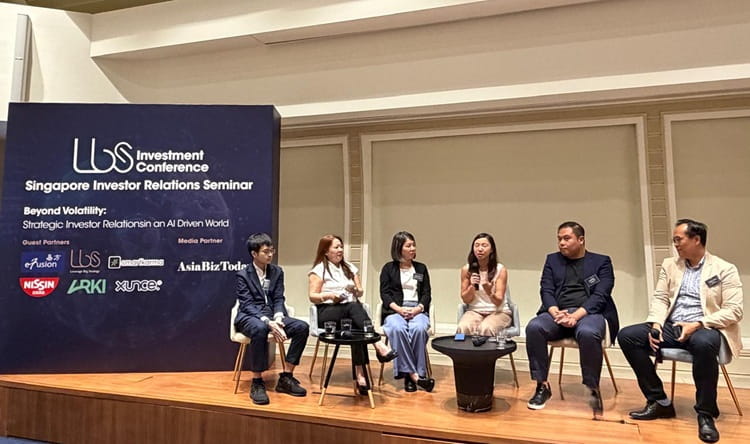
SINGAPORE, May 17, 2026 – Artificial intelligence is rapidly reshaping the investor relations landscape across Asia, forcing companies, investors and communications professionals to rethink how they engage markets, communicate narratives and maintain trust in an increasingly fragmented and data-driven financial ecosystem.
These themes formed the centrepiece of “Beyond Volatility: Strategic Investor Relations in an AI-Driven World”, a seminar hosted by LBS Communications Consulting Limited in Singapore, which brought together investor relations professionals, fund managers, technology experts, listed companies and communications strategists from across the region.
Opening the seminar, Joanne Chan, Managing Director of LBS Communications Consulting Limited, said investor communications is moving beyond traditional disclosure models toward a far more strategic and technology-enabled engagement framework.
“AI is changing investor communications at multiple levels, from how investors screen companies and consume research, to how management teams craft messages, manage volatility and build long-term trust,” Chan said.
“Today’s environment requires companies to move beyond traditional disclosure models towards more strategic, transparent and integrated investor engagement,” she added.
The seminar featured speakers from across the investment, technology, communications and listed company ecosystem, including Isaac Wong of eFusion Capital, Nirgunan Tiruchelvam of Aletheia Capital, Raghav Kapoor of Smartkarma, Fanny Yan of Nissin Foods Company Limited, Elaine Ang of EngageIR and David Ng of Arki Finance. The panel discussion was moderated by Justin Xiao of Clariti Financial.
AI Reshapes Investor Communications and Market Behaviour
A major focus of the discussions was the growing impact of AI-driven analysis and decentralised information channels on capital markets.
Isaac Wong, Portfolio Manager at eFusion Capital, observed that investor communications are moving away from traditional centralised channels dominated by sell-side research and institutional gatekeepers toward a more fragmented ecosystem shaped by social media platforms, podcasts, digital communities and AI-powered information systems.
“In the past, investor communications were far more centralised and controlled,” Wong said during his keynote address.
“Today, information dissemination channels are becoming more public, higher frequency and significantly more decentralised. AI can easily make rumours spread rapidly, and companies now need to think about how they track these channels and communicate effectively within them.”
Wong also highlighted the emergence of “agent-to-agent” interactions, where AI-driven portfolio management systems and AI-enabled investor tools could increasingly communicate directly with AI-powered corporate systems.
“We need to present information not just for humans, but also for AI agents,” he said. “Companies need better data ingestion, authentication and governance frameworks to operate effectively in this environment.”
Raghav Kapoor, Chief Karminator and Co-founder of Smartkarma, said investor relations is increasingly becoming a digital-first discipline powered by data analytics and cross-border investor engagement.
“Capital flows are increasingly global, and investor relations today needs to be digital first,” Kapoor said.
“Stories are only believable when they are backed by good information. Companies need to build data-driven narratives and stronger digital visibility if they want to improve liquidity, attract global investors and remain competitive.”
Kapoor added that many Asian companies continue to underinvest in digital investor relations capabilities despite the rapid shift in investor behaviour toward online and data-driven engagement channels.
Moderating the panel discussion, Justin Xiao, Principal of Clariti Financial, noted that investor relations professionals are increasingly required to navigate a far more complex communication environment shaped by AI, geopolitical uncertainty and rapidly evolving investor expectations.
“The challenge today is not simply communicating more information, but communicating with greater clarity, credibility and relevance in an environment where investors are processing information faster than ever before,” Xiao said during the discussion.
Storytelling, Trust and Human Engagement Still Matter
Despite rapid technological transformation, speakers repeatedly stressed that authentic communication and credible storytelling remain central to successful investor relations.
Nirgunan Tiruchelvam, Head of Consumer and Internet at Aletheia Capital, reflected on how dramatically the investor relations industry has evolved since the pre-internet era, when investor communication relied heavily on fax machines, Rolodex contact lists and in-person engagement.
“Information is readily available today, but stories are not,” Tiruchelvam said.
“The role of investor relations professionals is still to communicate a compelling narrative about why a company’s business model and outlook are superior. AI gives companies better tools, but the need for effective storytelling remains fundamental.”
Fanny Yan, Senior Manager of Investor Relations at Nissin Foods Company Limited, said investor relations functions today are becoming more strategic and responsive due to the speed at which information now moves through markets.
“Investor relations professionals today need to respond much more quickly to market developments, industry news and macroeconomic events because information now spreads very rapidly,” Yan said.
Elaine Ang, Managing Director of EngageIR, noted that AI-powered analytics tools are helping investor relations teams monitor market sentiment, analyse investor behaviour and respond more efficiently to misinformation or market rumours.
“AI is helping investor relations become more efficient, but it cannot replace the human element, especially the relationship-building and communication skills that remain critical in maintaining investor confidence,” Ang said.
David Ng, CEO and Co-Founder of Arki Finance, added that while AI is transforming financial communication, trust and transparency remain at the core of investor engagement.
“AI is an incredible enabler, but ultimately, investor confidence still depends on trust, transparency and human judgment,” Ng said during the panel discussion.
The seminar concluded with broad consensus that investor relations is rapidly evolving from a disclosure-focused support function into a strategic discipline that integrates technology, analytics, storytelling and stakeholder trust management.
As AI adoption accelerates across global financial markets, speakers agreed that organisations able to combine technological sophistication with authentic communication and credible long-term narratives are likely to emerge strongest in the next phase of capital markets evolution.