

As artificial intelligence accelerates cyber threats, Silent Push is betting on a fundamental shift in cybersecurity: identifying and disrupting malicious infrastructure before attackers can use it.
SINGAPORE, October 18, 2026 — Cybersecurity companies have traditionally focused on detecting and responding to attacks. But with artificial intelligence making cybercrime faster and more sophisticated, that approach may no longer be enough, according to Ken Bagnall, Founder and CEO of US-headquartered cybersecurity firm Silent Push.
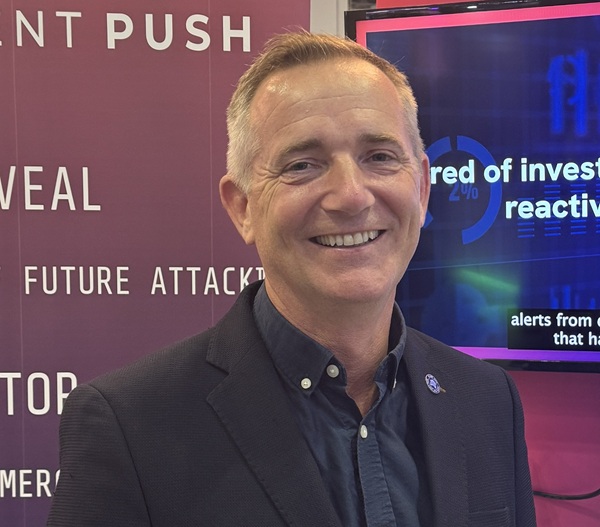
Speaking to AsiaBizToday for its Asia Insights interview series on the sidelines of Singapore International Cyber Week (SICW) 2026, Bagnall argued that the industry needs to move from reactive defence towards identifying cybercriminal infrastructure before attacks are launched.
“We have an average of 103 days advance notice of any campaign being launched,” he said, describing Silent Push’s approach to tracking infrastructure associated with emerging cyber threats.
The figure, according to Bagnall, represents the company’s average advance detection window rather than a guarantee for every attack. Sophisticated threat actors may prepare infrastructure months ahead, while less experienced attackers can move considerably faster.
From detecting attacks to preventing them
Silent Push specialises in what it calls Indicators of Future Attack (IOFA), identifying suspicious infrastructure, domains and networks that could be used in future cyber campaigns.
Unlike conventional security systems that rely heavily on signatures and indicators associated with known attacks, the company’s approach seeks to uncover an adversary’s infrastructure while it is still being assembled.
This distinction is becoming increasingly important as cybercriminals rapidly replace domains, servers and other infrastructure to evade detection.
“Threat actors have more and more infrastructure ready to go. And they churn through it really fast,” Bagnall explained.
For businesses, the implication is significant. Identifying malicious infrastructure early could allow security teams to block potential threats before attackers gain access to systems, steal credentials or compromise sensitive information.
AI is changing the economics of cybercrime
Bagnall believes artificial intelligence is lowering the technical barriers to cybercrime, enabling less experienced attackers to execute activities that previously required more sophisticated expertise.
This is particularly concerning in Southeast Asia, where organised scam operations have evolved into complex criminal enterprises supported by extensive digital infrastructure.
Rather than viewing individual fraudulent websites or applications as isolated threats, Bagnall advocates targeting the underlying networks that allow these operations to function.
He argued that taking down individual scam websites achieves little when criminal groups can quickly replace them.
The more effective response, he said, involves coordinated intelligence sharing and enforcement action across technology companies, governments and law-enforcement agencies.
Silent Push has participated in multinational disruption initiatives targeting cybercriminal networks, including operations involving US and Southeast Asian authorities.
These efforts illustrate a broader change in cybersecurity: moving beyond defending individual organisations towards dismantling the infrastructure supporting criminal activity.
Why Disrupting Cybercrime Infrastructure Matters
The challenge is particularly evident in the region’s scam economy. Criminal networks can operate numerous fraudulent websites and applications simultaneously, making conventional takedown efforts difficult to sustain.
Bagnall cited an engagement involving approximately 1.4 million fraudulent trading-related digital properties associated with a financial institution, illustrating the scale of the problem as described by the company.
For him, the priority is to identify the infrastructure supporting these operations and coordinate action against the networks behind them, rather than repeatedly removing individual websites.
The company is also using technology acquired through its purchase of HYAS to address threats concealed by residential proxy networks. These networks can make malicious traffic appear to originate from ordinary household internet connections, complicating efforts to identify suspicious activity.
Silent Push says its technology can help security teams distinguish between the apparent location of an IP address and the origins of traffic routed through it.
That capability could be particularly relevant to financial institutions confronting account takeovers, stolen credentials and fraudulent logins.
Singapore as a Regional Cybersecurity Hub
Asia-Pacific is an increasingly important market for Silent Push, with Singapore serving as its regional operating base.
The company has customers in Australia, South Korea and Japan, alongside personnel in the Philippines. Bagnall said government-related business currently accounts for much of its regional activity, although he expects commercial demand to expand over the next 18 to 24 months.
That growth could come from financial institutions and other enterprises seeking earlier intelligence about emerging threats.
Ultimately, Bagnall believes cybersecurity must become more proactive and accessible, particularly as AI increases the speed and scale of malicious activity.
For organisations, the strategic question is no longer simply how quickly an attack can be detected and contained, but whether the infrastructure behind it can be identified before the attack begins. That shift, he argues, will be central to the next phase of cybersecurity.