

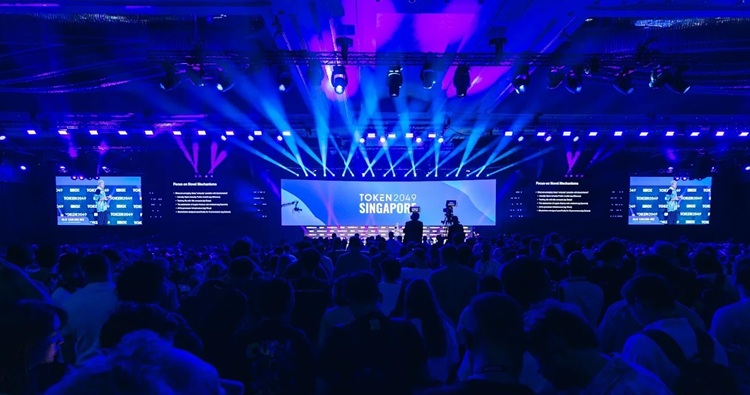
SINGAPORE, October 7, 2026: TOKEN2049 Singapore 2026 opened this morning at Marina Bay Sands, bringing together 25,000 attendees from 160 countries for two days of discussions, dealmaking and product announcements across the global digital asset industry.
The sold-out event, running on October 7-8, features 250 speakers across six stages and more than 500 exhibitors, making this one of the largest gatherings of crypto-native companies, investors, financial institutions and developers anywhere in the world.
This year’s speaker line-up includes Shayne Coplan, Founder and CEO of Polymarket; Jeff Yan, CEO of Hyperliquid Labs; Cameron and Tyler Winklevoss, Co-Founders of Gemini; Adena Friedman, Chair and CEO of Nasdaq; Jenny Johnson, CEO of Franklin Templeton; Arthur Hayes, CIO of Maelstrom; Tom Lee, CIO at Fundstrat and Chairman of Bitmine; Raoul Pal, Co-Founder and CEO of Real Vision; Balaji Srinivasan; and Eric Trump.
The opening comes as the digital asset sector increasingly straddles two worlds: the crypto-native ecosystem that built much of the industry and the growing participation of traditional financial institutions.
That convergence is becoming one of the defining themes of TOKEN2049 Singapore this year.
Institutional finance moves further into the conversation
One of the major additions to the 2026 edition is TOKEN2049 Institutional, which debuts on October 8. The private gathering will bring together 250 senior leaders from global finance and digital assets, with speakers and representatives from organisations including Goldman Sachs, BlackRock, Morgan Stanley, Solana Foundation and Franklin Templeton.
The launch of a dedicated institutional programme reflects how rapidly the market has evolved.
Institutional involvement in digital assets is no longer confined to exploratory conversations. Asset managers, banks, exchanges, market infrastructure companies and investment firms are increasingly engaging with questions around custody, tokenisation, liquidity, trading infrastructure and investment products.
For TOKEN2049, that has broadened the event beyond a traditional crypto conference into a meeting point between established finance and the digital asset economy.
The event is spread across all five floors of Marina Bay Sands, with six stages operating in parallel alongside dedicated networking lounges, co-working spaces and meeting zones.
Alex Fiskum, Co-Founder of TOKEN2049, said ahead of the opening that the conference had fully sold out and that several major announcements were expected during the two days.
“We’ve fully sold out ahead of the event and have an incredible programme lined up, our best yet,” he said. “Six stages will run in parallel across the two days, with some major announcements set to be made.”
Startups and developers get greater visibility
The event also places a strong emphasis on early-stage companies and builders. The NEXUS Startup Competition will see finalists compete for US$250,000, with judges from Dragonfly, Multicoin and Maelstrom.
For startups, the event offers access to investors, potential customers, strategic partners and talent in a highly concentrated environment.
The TOKEN2049 Origins Hackathon also returns for its second edition, bringing developers together for a 36-hour sprint with a US$150,000 prize pool.
The combination of investor-led startup competitions and developer-focused programmes underlines the event’s attempt to engage both capital and technical talent.
Another new feature this year is TOKEN2049’s first city pavilion.
The Dubai Pavilion includes ten exhibitors, among them Dubai’s Department of Economy and Tourism, the Virtual Assets Regulatory Authority, OMNIYAT, Emaar and Prima Luxury.
The pavilion reflects the growing international competition to attract digital asset companies, investment and talent.
Singapore and Dubai have become two of the most prominent global centres for the industry, and TOKEN2049 itself now operates major editions in both cities.
More than 500 exhibitors across the ecosystem
More than 500 exhibitors are participating in TOKEN2049 Singapore this year. Title Sponsors include OKX, Sui, BloFin, Mesh, BingX, TRON and Solana.
The exhibition floor reflects how much the digital asset industry has broadened.
Crypto exchanges and blockchain protocols remain prominent, but the ecosystem now encompasses institutional services, payments, market infrastructure, tokenisation platforms, developer tools, wallets and other technology providers.
The range of companies present points to an industry increasingly focused on applications and infrastructure rather than cryptocurrencies alone.
The conference is also the centrepiece of TOKEN2049 Week, with hundreds of side events being held across Singapore.
Venture capital firms, protocols, exchanges, infrastructure companies and industry groups are hosting parallel gatherings, making the week one of the busiest periods of the year for the city’s digital asset ecosystem.
The timing also coincides with Singapore’s Grand Prix weekend. TOKEN2049 is expected to welcome Formula One figures including Max Verstappen, Lando Norris and Jenson Button.
Singapore remains a key digital asset meeting point
The scale of this year’s event reinforces Singapore’s position as one of the industry’s major international meeting points.
The city combines access to capital, financial institutions, technology companies and regional markets, making it a natural venue for a sector that is becoming increasingly global and institutional.
What is particularly notable in 2026 is the widening gap between how crypto conferences were perceived several years ago and what they represent today.
The conversation has moved beyond trading and token prices. Institutional participation, infrastructure, regulation, product development, startup funding and market structure are now increasingly central to the industry’s agenda.
TOKEN2049 Singapore’s opening this morning provides one of the clearest snapshots of that evolution.
With 25,000 participants, hundreds of exhibitors and an expanding institutional presence, the event is no longer simply a gathering of the crypto industry. It is increasingly becoming a broader forum for how digital assets fit into the future of finance.