
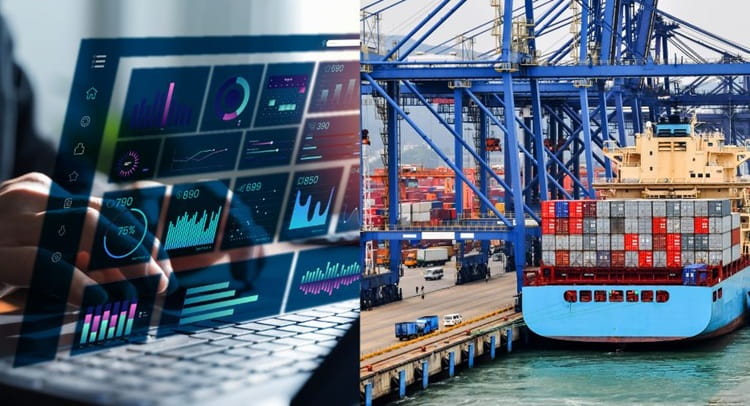
SINGAPORE, July 16, 2026 – Artificial intelligence is no longer a boardroom experiment, a pilot programme or a future-facing technology promise. It is already operating inside ports, banks, fraud detection systems, logistics networks and supply chains, according to Anand Patil, Senior Director, CX Solutions at Cisco.
Speaking at the Singapore launch of DMCC’s Future of Trade 2026: Rebuilding Through Rupture report, Patil said the question is no longer whether AI is real, but whether businesses and infrastructure are ready for it.
“AI has crossed the operational point of no return,” Patil said. “It is not a pilot. It is not a slide in the strategy deck anymore. It is operational. It is moving cargo. It is moving money. It is moving cities.”

His comments align with one of the report’s central findings: AI has moved from experimentation to operational reality. The report states that agentic AI systems are now making operational decisions once reserved for human traders, including in supply chain forecasting, customs compliance and customer engagement.
Singapore’s Port Shows AI at Work
Patil pointed to Singapore’s port ecosystem as a live example of AI operating at scale. He described how, less than an hour from the launch venue, the Port of Tuas already demonstrates the shift from manual operations to autonomous, data-driven decision-making. Autonomous guided vehicles operate without drivers, cranes are controlled through command centres, and a digital twin of the facility receives real-time telemetry data from across the port.
That system, he said, determines which containers should move next, what route they should take and how incoming vessels should adjust their speed so that berths are ready when they arrive.
“Why do I tell you this story? Because this is not a science project,” Patil said. “It is a regular Wednesday morning in Singapore.” The example is important because it moves the AI discussion away from generative AI as a workplace tool and into AI as operating infrastructure.
In trade, AI is now being used to route containers, manage port assets, improve vessel movement, detect fraud, forecast supply chains and support customer engagement. The technology is no longer sitting only in innovation labs. It is increasingly embedded in the systems that move goods, capital and data.
AI-Related Goods Are Reshaping Trade Growth
DMCC’s report shows that AI is also changing what gets traded. AI-related goods, including semiconductors, servers and data centre hardware, expanded at five times the rate of non-AI goods in the first half of 2025. Although AI-related goods represented 15% of global trade by volume, they accounted for 43% of trade growth during that period.
This is reshaping which countries and corridors gain influence. Malaysia, Singapore, Thailand and Vietnam together accounted for nearly 30% of global semiconductor export growth by 2024, making Southeast Asia one of the world’s fastest-growing AI manufacturing ecosystems.
For ASEAN, this creates a major opportunity. The region is already benefiting from supply chain diversification and rising demand for electronics, semiconductors, AI infrastructure and data centre equipment. But to capture the next phase of value, economies will need to move beyond assembly and into higher-value capabilities around design, deployment, services, data infrastructure and AI governance.
AI in Banking and Fraud Detection
Patil also used a banking example to show how AI is already operating in real-world financial systems. He described a Singapore doctor who was targeted by scammers posing as government investigators and persuaded to initiate a transfer of around half a million dollars. According to Patil, DBS detected an anomaly as the transfer was being initiated. When the analyst could not reach the doctor directly, she contacted his wife, a joint account holder, and the transfer was stopped before any money was lost.
“That’s the partnership in action,” Patil said. “AI was able to very quickly recognise the pattern, but it took a human to understand it and take action on it.”
This is a useful reminder that the most valuable AI use cases in trade and finance may not be fully autonomous. They are often hybrid systems where AI identifies risk, detects patterns and accelerates decisions, while human operators provide judgement, accountability and intervention.
Patil also noted that DBS had realised more than US$1 billion of value from AI in 2025, signalling that large enterprises are already seeing measurable business impact from AI deployment.
Infrastructure Readiness Is the New Bottleneck
The report and Patil’s remarks both suggest that AI adoption is no longer limited by ambition. It is increasingly constrained by readiness.
Patil said the problem is “not intent or ambition”, but whether enterprise infrastructure is prepared for AI workloads. He noted that Cisco’s annual AI readiness research found that more than half of surveyed organisations reported their networks were not ready enough to run AI, while only 15% could call their networks truly flexible.
That makes AI a trade infrastructure issue, not just a software issue. AI requires networks, cybersecurity, data centres, chips, power, cloud infrastructure, governance and skilled people. As AI becomes embedded in supply chains, ports, banks and customs systems, weak infrastructure could become a competitive disadvantage.
The DMCC report also points to a widening talent gap. It notes that there are more than 1.6 million open AI-related positions worldwide, but only about half a million qualified professionals to fill them. It also states that 85% of technology executives have postponed or slowed important AI projects because of talent constraints.
For companies, this means AI strategy must now include workforce planning, infrastructure investment and governance design. For governments, it means AI readiness is becoming a national competitiveness issue.
The operationalisation of AI is creating a divide between early movers and laggards. DMCC’s report says only 14% of businesses describe their AI use as transformational or integrated, while more than 25% report no meaningful adoption.
This gap matters because AI will increasingly influence productivity, trade efficiency, compliance capability, market intelligence and customer responsiveness.
Companies that can integrate AI into real operations will be able to forecast demand more accurately, manage disruptions faster, reduce fraud risk, optimise logistics and improve decision-making. Those that remain stuck in experimentation may find themselves falling behind not only technologically, but commercially.
Asia’s AI Trade Opportunity
For Asia and ASEAN, AI is both a market opportunity and a structural test. The region is already important in AI-related goods, particularly semiconductors and hardware. It is also seeing rapid growth in digital services, data infrastructure, payments and logistics technology.
But the next phase will require more than export growth. It will require trusted AI systems, resilient networks, skilled talent, cybersecurity capability and policies that allow AI to operate safely across borders and sectors.
Patil’s Singapore examples show what that future looks like in practice. AI is not simply generating text or improving productivity in offices. It is helping ports move containers, banks stop fraud, and cities manage complex operations.
For global trade, that is the deeper shift. AI is becoming part of the operating system of commerce. The winners will be the businesses and economies that build the infrastructure, talent and trust needed to deploy it at scale.