
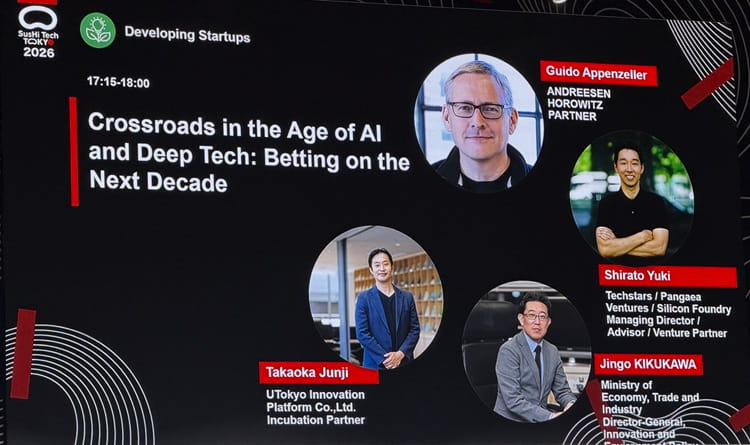
TOKYO, April 28, 2026 – As SusHi Tech Tokyo 2026 brought together founders, investors and policymakers from across the world, one of the most closely watched sessions centred on a critical question: where should Japan place its bets for the next decade of innovation?
The panel discussion, “Crossroads in the Age of AI and Deep Tech: Betting on the Next Decade,” brought together Guido Appenzeller, Partner at Andreessen Horowitz; Jingo Kikukawa from Japan’s Ministry of Economy, Trade and Industry (METI); and Junji Takaoka, Incubation Partner at UTokyo Innovation Platform Company. The session was moderated by Shirato Yuki of Techstars.
The discussion moved well beyond startup optimism, focusing instead on the structural choices Japan must make if it wants to lead globally in AI, robotics and deep tech.
Why Robotics and Physical AI Could Be Japan’s Defining Advantage
For Guido Appenzeller, the answer was clear: Japan’s strongest opportunity lies in robotics and physical AI, where its deep manufacturing expertise creates a unique global advantage. He argued that robotics is one of the few sectors where Japan’s industrial base naturally supports startup innovation.
“Japan has a lot of expertise in manufacturing the parts that go into these robots,” he said, pointing to the country’s strength in vertically integrated development where hardware and software evolve together. He compared robotics to autonomous vehicles, where complex mechanics and software must be developed in tandem, noting that Japan’s manufacturing depth allows for faster iteration cycles.
He also highlighted a growing global trend that could work in Japan’s favour: the desire, particularly in the United States, to reduce dependence on Chinese supply chains. “With more desire to decouple from Chinese supply chains, Japan becomes one of the most viable alternatives,” he said.
For Appenzeller, robotics may not be the only opportunity, but it remains his “number one” focus area.
Government Policy Must Move Beyond Borders
From the government perspective, METI’s Jingo Kikukawa stressed that AI leadership will depend heavily on how countries handle data, talent and international collaboration.
“I think the first issue is physical AI, but we need to think about how to deal with the data issue,” he said.
He emphasised the importance of sharing data not only within Japan’s startup ecosystem but also with like-minded partner countries such as the United States.
“How to exchange data and how to work with our friend, the US, is a significant point,” he noted.
Kikukawa also argued that Japan should avoid limiting its ambition to domestic startups alone.
He pointed to Japanese founders launching businesses in the US and then returning to scale in Japan, stressing that support systems must follow talent rather than geography.
“We should not limit ourselves only to Japanese startups. We need to support talent wherever they launch,” he said.
His comments reflected a broader shift in Japanese policy thinking, from protecting local ecosystems to actively participating in global ones.
The Missing Ingredient: Global Ambition
One of the strongest messages of the session came from a simple cultural comparison. Appenzeller reflected on his experience around Stanford, where founders often begin with what sounds like an unrealistic ambition.
“They say, we want to start a company and become the world leader in something,” he said. Even before building a product, these founders think globally. “It sounds crazy. But sometimes it works,” he said, referencing companies like Google.
More importantly, he argued, without that mindset success becomes almost impossible. “If you don’t start with that idea, it will definitely not work. You have to go in with the idea that you are building a global company.”
This was a point Kikukawa also acknowledged, noting that some international investors view Japanese founders as technically strong but often lacking sufficient ambition.
He pointed to government programmes through JETRO and METI that aim to send founders into global markets earlier. “As I always say, go global and be global,” he remarked.
Dual Use Technologies and Japan’s New Strategic Reality
A major part of the discussion also focused on dual-use technologies, an increasingly important and sensitive subject in Japan.
With policy shifts around defence exports and growing attention to economic security, technologies such as drones, quantum computing and robotics are being viewed through both civilian and strategic lenses.
Kikukawa acknowledged the political sensitivity but stressed that the government is now taking a broader view.
“Deep tech and cutting-edge technologies are always dual use,” he said, pointing to drones that can support both defence operations and disaster response.
He referenced real examples such as drones being used to deliver medical equipment during disaster recovery, illustrating how the same technology can serve multiple national priorities.
METI is now expanding programmes like SBIR (Small Business Innovation Research) to ensure the government itself can become an early customer for startups.
“The government should sometimes be the first client for the startup,” he said. This shift could become a major unlock for deep tech ventures that need early validation before commercial scale.
Can Japan Build the Next Global Unicorn?
The final question of the session looked ahead: can Japan still produce globally dominant companies in the AI era?
Takaoka remained optimistic. He pointed out that many of Japan’s most valuable companies were built around manufacturing, and while the next generation may look different, the opportunity remains strong.
“We are now living in the age of AI,” he said, adding that the next unicorn will almost certainly be connected to AI in some form.
Kikukawa agreed, adding that Japan may have an unexpected cultural advantage. Unlike Western markets where AI often triggers anxiety around job losses or dystopian narratives, Japan tends to be more comfortable with robots and automation.
“We don’t have this Terminator culture,” he said, pointing to Japan’s long-standing cultural familiarity with robotics. This, he suggested, makes Japan one of the best places in the world to build AI-driven businesses.
As SusHi Tech Tokyo 2026 continues, the message from the panel was clear: Japan has the ingredients, manufacturing strength, research depth, policy support and cultural openness.
The next challenge is not capability, but conviction. To win the next decade, Japan must think bigger, move faster and build with global ambition from day one.