

By Manoj Aravindakshan
At SusHi Tech Tokyo 2026, a frank conversation between a Keidanren powerhouse and a top Silicon Valley investor unpacked why Japan has been watching the world’s biggest tech waves and what it would take to finally ride one.
Amid the product demos and pitch contests of SusHi Tech Tokyo 2026, was a candid, almost uncomfortable conversation between two people who know the stakes well.
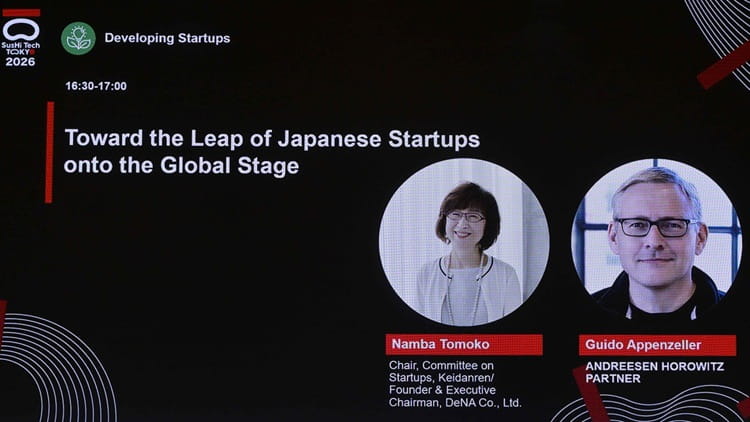
Tomoko Namba, Executive Chairman of DeNA and Chair of Keidanren’s Committee on Start Ups, and Guido Appenzeller, Partner at Andreessen Horowitz, sat down for a discussion titled “Toward the Leap of Japanese Startups onto the Global Stage”.
What followed was part diagnosis, part rallying cry and a sobering reminder of how high the ceiling is that Japan has yet to break through. The discussion explored the structural and cultural barriers that continue to hold back Japan’s startup ecosystem: from the country’s relatively small number of unicorns and limited overseas venture funding to what many describe as a “domestic-first” mindset that discourages companies from thinking globally from day one.
A Supercycle Japan Cannot Afford to Sleep Through
Appenzeller opened with a framing that was difficult to argue with. We are, he suggested, living through a genuine technology supercycle- a rare, compressed period in which so much that is new is happening simultaneously that it reshapes entire industries.
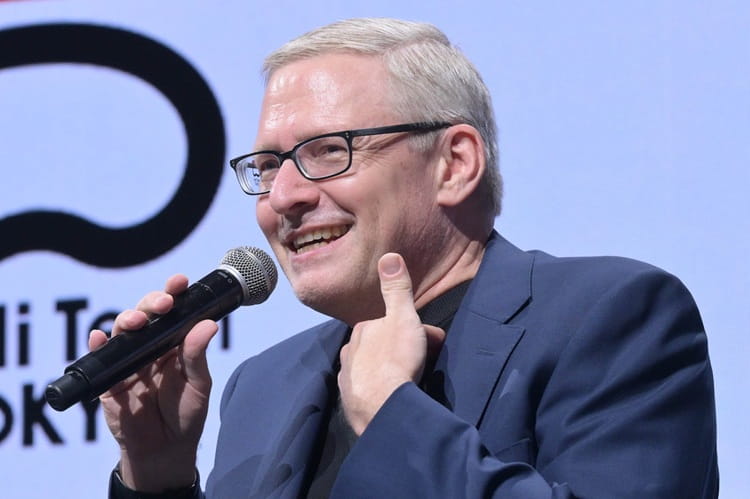
“This is an incredibly exciting time for tech,” he said, comparing today’s AI-driven transformation to the dot-com boom of the late 1990s and early 2000s. That boom produced durable, world-defining companies: of the ten most valuable corporations on Earth today, nearly half were either born or started to come of age during that period. The clear implication was that moments of technological transition create opportunities for entirely new players to emerge, provided they move fast enough.
Namba pressed it home with a sobering observation about Japan’s side of the ledger. None of the ten largest companies in Japan by market value, she noted, is less than thirty years old. The country watched the dot-com supercycle from the sidelines, at least in terms of producing globally dominant new enterprises. The question that hung over the room was whether Japan was about to make the same mistake again.

It is a question with hard numbers behind it. Despite being the world’s third-largest economy, Japan currently counts somewhere between ten and fifteen unicorn startups. In contrast, the United States has over 850 and India has more than 80. Even smaller economies like the United Kingdom and France have pulled significantly further ahead. Japan’s government has set an ambitious target of 100 unicorns by 2027, backed by substantial public investment, but at the current pace the gap between ambition and reality remains wide.
Software Development Has Been Reset. Is Japan Ready?
Much of the discussion focused on the transformative impact of AI on software development and the broader technology economy.
“Software is more important than hardware,” Appenzeller remarked, noting that the way we build it has undergone the most dramatic disruption. The nature of software development, he said, is being fundamentally rewritten by generative AI and autonomous agents. “Very few people are now writing code,” he observed, adding that the emphasis is shifting away from manual coding toward defining specifications, workflows and instructions. The focus has migrated from execution to articulation.
That change, he suggested, could dramatically alter the economics of software development and outsourcing and lead to a “full reset” of the software market, disrupting everything from the outsourcing industry to the cost structures of development. Beyond the cost of developers themselves, the economics of AI computation, particularly token costs and infrastructure spending, are becoming increasingly important.
Appenzeller also touched on AI becoming a participant in commerce itself. The world is entering an era where software agents are not only assisting humans but increasingly making purchasing and procurement decisions autonomously. Some companies in the Andreessen Horowitz portfolio are already building products not for human buyers, but for AI agents that are beginning to handle procurement decisions. The customer, in other words, will not always be a person.
Agile Start Ups Can Beat The Big Guys With Fast Execution
Despite the enormous financial and infrastructure advantages enjoyed by large technology companies, Appenzeller argued that fast execution by startups can outmanoeuvre incumbents.
“The big guys don’t always win,” he said, pointing to the growth of Cursor AI, the AI-native coding tool built by a small team from MIT as a case in point. Cursor AI has in roughly two years grown to over $2 billion in annualised revenue and a valuation exceeding $29 billion, a direct and very public challenge to Microsoft’s GitHub Copilot, a product backed by one of the largest technology companies in the world.
Large incumbents, for all their resources, face what Clayton Christensen famously described as the Innovator’s Dilemma, the structural difficulty of disrupting themselves. The window that Cursor exploited against Microsoft is the same kind of window that exists, in various forms, across every industry being touched by AI.
For startups with the agility to redesign their models around these new economics, the opportunity is significant. On the other hand, the risk of being overtaken is real for larger organisations anchored to older assumptions.
Cause for Optimism and Advice for Japanese Start Ups
The most interesting part of the discussion for Japanese startups, however, may have been Appenzeller’s explanation of why he remains optimistic about Japan’s prospects. He pushed back gently against the idea that Japan needs to become something it is not in order to succeed globally.
He identified three pillars of Japanese potential:
- The Erasure of Language Barriers: Improvements in AI-driven translation are finally neutralizing the constraints and barriers posed by linguistic limitations that once kept Japanese founders tethered to the domestic market.
- Trust: There is a deep-seated trust and affinity for Japanese brands and founders in the American market.
- The Manufacturing Legacy: Japan’s historical strength in hardware and manufacturing provides a unique foundation as AI begins to integrate more deeply with the physical world. The country carries genuine credibility built over decades of excellence in manufacturing, engineering, and product quality that translates to meaningful advantage in an era when the physical world and the digital world are converging. Japan’s strengths in hardware and manufacturing are precisely the capabilities that matter as AI moves from pure software into robotics, physical automation, and what the industry is calling physical AI.
The advice he offered to Japanese founders was simple: find a market with enormous potential, build from your genuine strengths, and worry less about the areas where you are not competitive.
Investors at firms like Andreessen Horowitz, he said plainly, are always looking for great companies with considerable potential and where a company is based is a secondary consideration when the opportunity is compelling.
Breaking the Ceiling
The message from this particular conversation at SusHi Tech Tokyo was loud and clear: the global stage is waiting. For Japanese startups, the “ceiling” isn’t a lack of technology or talent—it’s a mindset. Japan now has a genuine shot at a new dawn in tech.
The comments carried particular resonance given Andreessen Horowitz’s recent investment activity in Japan. In February 2026, the Silicon Valley venture capital giant led a seed round for Shizuku AI, a Tokyo-based startup creating AI-native virtual characters, capable of conversing with users, remembering interactions and providing ongoing personal support — an emerging category attracting increasing global investor attention. Notably, DeNA is also listed among Shizuku AI’s backers, a detail that points to the intersecting networks of capital and credibility beginning to form around Japan’s emerging AI layer.
The investment has also fuelled speculation that Andreessen Horowitz may deepen its presence in Japan. When asked directly about rumours that the firm could open a Japanese office, Appenzeller declined to either confirm or deny the possibility. Yet, the broader message of the session was already unmistakable.
The global AI race is creating a rare window where established hierarchies can be disrupted, new leaders can emerge and geographic boundaries matter less than before. For Japan, the challenge may no longer be technological capability, but whether its startups can think and act globally enough to seize the moment before the window closes again.
Manoj Aravindakshan is Consulting Editor at AsiaBizToday and also Managing Director of Digital Marketing company On Target Media & Marketing Services Pte. Ltd.