

SINGAPORE, February 11, 2026 — Artificial intelligence may dominate headlines through chatbots and generative interfaces, but beneath the surface, enterprise infrastructure is undergoing a more profound shift. According to the newly released Azul 2026 State of Java Survey & Report, 62 percent of enterprises now use Java to code AI functionality, up from 50 percent last year.
At a select media interaction today, Dean Vaughan, Regional Vice President for Asia Pacific and Japan at Azul, emphasised that the real growth story lies not in AI front-end applications, but in the middleware and data systems that power them.

“We tend to think about AI as the front end, the chatbot, the interface. But the real growth is in all the applications that sit behind it,” Vaughan said. “Kafka, Elasticsearch, HBase, Spark, all of that backend infrastructure is what makes AI work at scale. And almost all of that runs on Java.”
Java: The Quiet Engine of Enterprise AI
While languages such as Python are widely used for AI prototyping and model development, production-scale AI systems remain heavily dependent on Java-based infrastructure. The survey confirms that 31 percent of respondents now embed AI functionality into more than half of the Java applications they build.
This reflects a broader enterprise shift: AI is no longer experimental. It is being integrated into:
- Customer service systems
- Payment processing platforms
- Risk and fraud detection engines
- Recommendation and personalization systems
In these environments, AI front ends rely on high-speed data retrieval, real-time transaction processing and secure, scalable application servers, domains where Java has historically dominated. “If ChatGPT is the interface, the real brains are in the backend systems. And those backend systems are overwhelmingly Java,” said Vaughan.
AI Is Driving Infrastructure Stress — and Cloud Cost Escalation
The AI surge is creating pressure on enterprise compute infrastructure across Southeast Asia.
The report reveals that 97 percent of enterprises have taken steps to reduce public cloud costs, and 41 percent are using high-performance Java platforms specifically to cut cloud compute expenditure.
More strikingly, 74 percent of organisations report more than 20 percent unused compute capacity in public cloud environments, often due to overprovisioning to compensate for inconsistent runtime behaviour or slow warm-up cycles.
According to Vaughan, AI is amplifying this inefficiency. Payment processors and digital banks, particularly in Indonesia, Thailand and India, are facing explosive growth in transaction volumes as Southeast Asia accelerates its transition toward cashless societies. Instead of expanding hardware footprint indefinitely, some organisations are optimising the Java runtime layer itself to reduce compute requirements.
Optimised Java as a Cost Lever
Azul positions itself as the only company 100 percent focused on advancing Java and the JVM. Its commercial OpenJDK offerings include:
- Azul Platform Core, which claims up to 70 percent cost savings compared to Oracle Java
- Azul Platform Prime, an enhanced OpenJDK runtime with advanced JIT compilation and low-latency garbage collection designed to reduce cloud costs by up to 50 percent.
The strategy is straightforward: faster code equals fewer compute resources, which translates directly into lower cloud bills.
This aligns with survey findings showing that enterprises most heavily invested in Java — where at least 90 percent of applications run on Java — are significantly more likely to adopt high-performance runtimes.
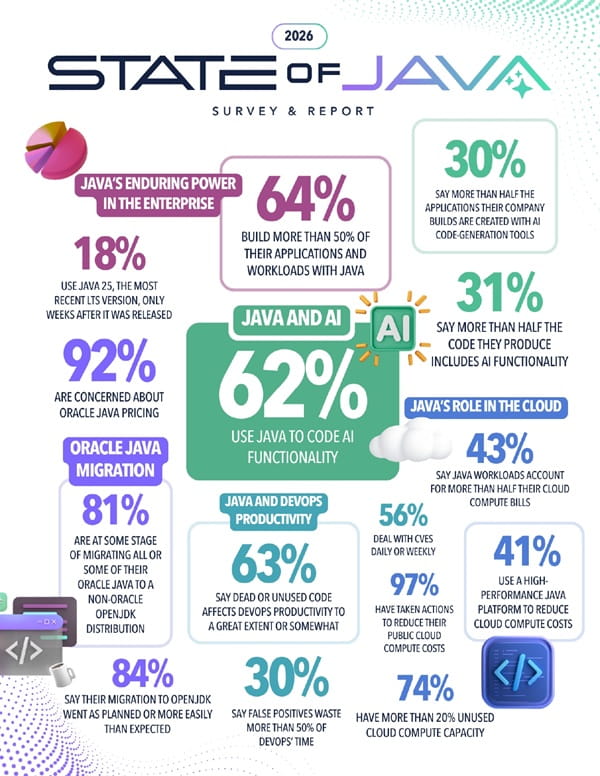
Beyond performance, cost pressure is reshaping Java strategy. The survey reports that 92 percent of respondents are concerned about Oracle Java pricing, and 81 percent are migrating or planning to migrate at least part of their Java estate to non-Oracle OpenJDK distributions.
Oracle’s employee-based pricing model has intensified scrutiny, particularly in labour-intensive industries such as banking in Indonesia, where headcount can materially influence licensing costs. Cost (37 percent) remains the primary migration driver, followed by open-source preference and audit risk concerns.
Southeast Asia: A High-Growth AI Infrastructure Market
Vaughan highlighted a distinct regional dynamic. Unlike Australia, where enterprises often adopt US-based platforms such as Amazon or Uber, Southeast Asia’s multilingual environment has fostered strong domestic technology ecosystems. Indonesia and Thailand in particular have large local tech players building their own payment, logistics and digital service platforms.
As these platforms embed AI into customer engagement and transaction workflows, backend Java infrastructure requirements scale accordingly.
The strongest demand growth, Vaughan said, is coming from:
- Banking and financial services
- Utilities, due to regulatory compliance requirements
- Payment processing firms
- Large local technology companies
In highly regulated, mission-critical sectors such as utilities, supported software stacks are non-negotiable. In fast-growing fintech and payment ecosystems, scalability is paramount. As AI increases system complexity, DevOps and security teams are under growing strain to maintain performance without compromising resilience.
Java’s Strategic Durability in the AI Era
Despite rapid language innovation and the prominence of Python in AI tooling, Java remains deeply embedded in enterprise production systems.
Azul supports nearly 1,000 customers globally, including more than 35 percent of the Fortune 100 and all of the world’s top 10 financial trading companies. The broader takeaway is that AI may redefine user interfaces, but enterprise scalability remains dependent on backend infrastructure — and that infrastructure remains overwhelmingly Java-driven.
In Southeast Asia’s high-growth, cashless and digitally expanding markets, the pressure to scale backend systems efficiently is likely to intensify. “I’m not seeing organisations switch programming languages. I’m seeing them need more of what they already run, because the demand on that infrastructure is exploding,” summarised Vaughan.
For enterprise technology leaders, Java’s relevance in 2026 is not nostalgic. It is structural.