
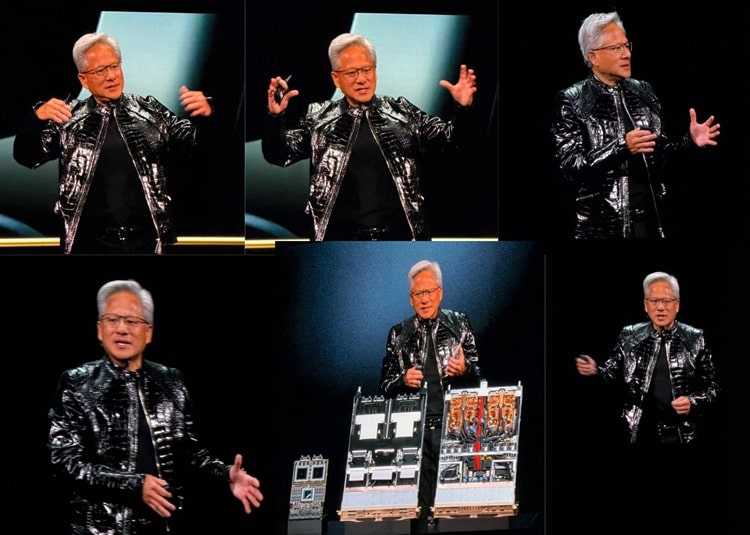
LAS VEGAS, January 6, 2026 — At the heart of CES 2026, Nvidia Founder and CEO **Jensen Huang delivered a keynote address that set a bold tone for the year ahead — one in which artificial intelligence no longer lives just in software, but increasingly interacts with and operates within the physical world. Huang’s presentation crystallised Nvidia’s belief that “Physical AI” — machines that not only compute but understand and act on physical reality — will define the next era of innovation.
Held at the Fontainebleau Las Vegas before an overflow crowd of journalists and tech leaders, Huang’s keynote positioned Nvidia not simply as a developer of chips and AI models, but as an architect of an ecosystem where reasoning machines, autonomous vehicles, robotics, simulation and AI infrastructure come together to reshape industries.
From Virtual Intelligence to Physical Intelligence
Huang framed this shift as akin to a “ChatGPT moment for physical AI” — a turning point where AI moves beyond processing language and data to understanding the laws of the physical world, such as motion, causality and object permanence. This leap toward embodied intelligence suggests a future where machines can reason about and operate safely in real environments, rather than being confined to screens or data centres.
Central to Nvidia’s physical AI strategy are new models and tools that blend simulation, synthetic data, world understanding and action-oriented learning. Nvidia showcased advanced frameworks like Cosmos and GR00T, designed to train robots and autonomous systems in virtual environments that faithfully replicate real-world physics. These systems help machines learn not just to recognise patterns, but to make decisions and act upon them in complex scenarios.
Alpamayo and Autonomous Reasoning
One of the most eye-catching moments of the keynote was the introduction of “Alpamayo,” Nvidia’s new world foundation model specifically designed to power reasoning in autonomous driving. Nvidia demonstrated a Mercedes-Benz CLA equipped with this AI navigating urban traffic — stopping at lights, yielding to pedestrians and changing lanes — all with no human intervention aside from supervision. Huang described this evolutionary leap as a step toward reasoning-based autonomy, moving the industry closer to truly intelligent self-driving systems.
Unlike earlier approaches that relied heavily on pattern recognition alone, Alpamayo combines perception, reasoning and contextual understanding — the hallmarks of what Nvidia executives believe will underpin next-generation autonomous machines.
Rubin, Compute, and the AI Infrastructure Stack
Huang also used the keynote to highlight Nvidia’s next major leap in AI hardware: the Vera Rubin computing platform. Now in full production, Rubin represents an integrated stack of new CPUs, GPUs and networking components designed to dramatically boost performance for large-scale AI tasks, including physical AI and reasoning workloads. Nvidia claims that Rubin can deliver up to five times the training performance of its predecessors, significantly lowering the cost and time required for training advanced models.
This emphasis on high-performance computing and AI infrastructure underscores how Nvidia is positioning itself not only as a chipmaker, but as the backbone for a broad swath of intelligent systems that will power robotics, autonomous vehicles, healthcare, industrial automation and more.
Industry Implications and the Path Ahead
Huang’s CES keynote reflects a broader industry sentiment: AI is no longer a siloed software trend but a catalyst for reshaping physical technologies. From autonomous robots in factories and service roles to advanced mobility systems, the integration of reasoning-capable AI into hardware signals a major pivot in how companies innovate and deploy intelligent systems.
For AsiaBizToday and other media covering CES 2026, Nvidia’s keynote was more than a product reveal — it was a strategic declaration that the future of AI is physical, agent-based, and deeply intertwined with how machines perceive and interact with the world around us. How businesses, policymakers and global technology ecosystems adapt to this vision will be one of the defining stories of 2026 and beyond.
Stay tuned for ABT’s continued on-ground coverage from CES 2026, including interviews with industry leaders and deeper dives into the innovations shaping the next phase of the AI revolution.