
By Vishwesh Iyer
SINGAPORE, June 12, 2026 – The next major shift in financial services may not be driven by artificial intelligence alone, but by the convergence of AI agents, stablecoins, tokenised assets and regulated digital finance infrastructure, according to Dr Bo Bai, Executive Chairman of Alpha Ladder Group, and Co-Founder of MetaComp.
Speaking to Asia Insights on the sidelines of SuperAI Singapore 2026, Dr Bo said the financial services industry is entering a period of structural transformation, with payments, wealth management and customer interactions all moving towards more hybrid models.
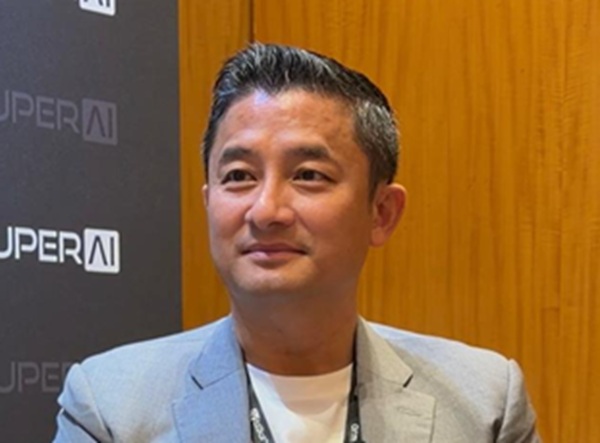
“I see the rising power of hybrid,” he said, referring to the convergence of fiat and digital payments, traditional wealth services and Web3-enabled finance, as well as human and AI-led decision-making.
According to Dr Bo, the future of financial services will not be purely digital, purely fiat, purely human-led or purely AI-driven. Instead, it is likely to involve a combination of regulated institutions, digital assets, artificial intelligence and human oversight.
“This is money. This is not trying to create a movie or entertainment piece,” he said. “Those are the money you don’t want to lose. We work very hard to make you money. You don’t want your agent to just lose it too easily.”
His comments come at a time when AI agents are becoming one of the most widely discussed themes at SuperAI Singapore 2026. As AI systems move from generating content to taking action on behalf of users, the financial services sector is beginning to examine how such agents could interact with payments, accounts, wallets, investments and regulated financial platforms.
Hybrid Payments and the Rise of Agent Finance
Dr Bo believes the next phase of financial innovation will involve what he describes as hybrid payments and hybrid wealth. In payments, this could mean a combination of local fiat currencies, stablecoins and tokenised assets being used across different contexts. In wealth management, it could involve a combination of traditional broker-dealer models, regulated digital asset platforms and AI-powered advisory or execution tools.
“The wealth is not purely done by our traditional old broker-dealer way, but it will not be purely just by those Web3 guys. It is going to be a combination,” he said. He added that decision-making and access to financial services would also evolve into a hybrid model, with human beings and AI agents working together under appropriate governance structures.
That governance layer, he stressed, will be central to whether agentic finance can scale responsibly. “It’s all about governance, anti-money laundering, safety and security. A lot of the matters need to be gradually addressed by the industry,” he said.
Dr Bo said this is particularly important because financial services differ from many other AI use cases. While AI may be able to automate many workflows, decisions involving money, transactions and wealth require stronger control mechanisms, auditability and accountability.
The emergence of AI agents in finance also raises new questions for banks, payment firms, digital asset platforms and regulators. Who should be allowed to provide financial services through an agent? Which agents should be allowed to receive financial services? How should human authorisation be verified? How should transactions be monitored? And how should financial institutions respond if an agent is copied, compromised or misused?
Stablecoins, CBDCs and Tokenised Gold
On the future of cross-border payments, Dr Bo said central bank digital currencies, or CBDCs, have so far not gained significant traction in cross-border settlement. He noted that cross-border CBDC use is inherently complex because transactions usually involve at least two jurisdictions, creating questions about which country’s digital currency should be used and how settlement rails should be governed.
By contrast, he said US dollar-denominated stablecoins have increasingly become a practical tool for cross-border settlement. “In our view, the stablecoins denominated in US dollars are providing a complementary solution to SWIFT, making cross-border settlement faster and more efficient,” he said.
However, Dr Bo also pointed out that the rise of US dollar stablecoins could reinforce the dominance of the US dollar in global finance. He expects more countries to continue exploring CBDCs and fiat-backed stablecoins, but he believes adoption has so far been limited outside the US dollar stablecoin market.
Looking ahead, he sees another asset returning to relevance in global payments: gold. “With increasingly complex geopolitics in the next decade, gold will probably play another significant role for payments,” he said.
Dr Bo pointed to tokenised gold products such as Tether Gold and other gold-backed tokens as examples of how traditional stores of value could be integrated into modern digital settlement systems. He said tokenised gold could complement or partially substitute US dollar stablecoins in certain cross-border payment contexts, particularly as geopolitical uncertainty encourages alternative settlement mechanisms.
“Stablecoin may start with the US dollar stablecoin, and most likely the next wave will have some gold token in my mix,” he said. For Asia, this could open new opportunities. Dr Bai said the region’s exporting economies, digital payment infrastructure and cross-border commercial flows make it well positioned to benefit from hybrid payment models involving local fiat currencies domestically and stablecoins or gold tokens across borders.
He noted that Asia’s trade links extend not only within the region but also to Latin America, the Middle East and Africa. This makes efficient settlement infrastructure increasingly important for companies expanding globally.
Why “Know Your Agent” Could Become Critical
A major part of Dr Bo’s argument centres on the need for new governance standards around AI agents in finance. He said traditional finance can be simplified into five core functions: know your customer, anti-money laundering and transaction monitoring, accounts, payments and wealth. In an agentic finance environment, all five will need to be rethought.
“The top of the list is which agent is allowed to provide a financial service and which agent is allowed to receive a financial service,” he said.
To address this gap, MetaComp has developed what Dr Bo calls a “Know Your Agent” framework, or KYA. The framework is designed to establish who owns an AI agent, who controls it, whether the underlying person or legal entity has gone through proper KYC, and whether there are sufficient safeguards between the human user, corporate entity and AI agent.
“We want to understand who owns this agent, who controls this agent, do we have proper KYC of that who, and do you have enough governance and safeguarding rail between that person or legal entity and this agent?” he said.
According to Dr Bo, only after these conditions are met should a financial institution feel comfortable providing services to an AI agent.
He believes KYA is a missing piece in the emerging agentic finance ecosystem. “If you don’t pass that standard, you cannot sufficiently prove that you own and control that agent. You cannot sufficiently prove that you are the right person to be KYC-ed. You cannot sufficiently prove every single step has proper human monitoring and human control,” he said.
He warned that agentic finance will inevitably attract fraud, scams and impersonation attempts, just as earlier waves of technology did.
“In the old days, when the internet got started, how often was the internet used for scamming? Even now, when blockchain got started, how often were they used for scamming? Similarly, I expect to see tons of agentic scamming,” he said.
This could include attempts to copy an agent, impersonate an authorised agent or use compromised agents to move money. For this reason, Dr Bo said Know Your Agent should not be a one-time check. It must be a continuous governance process involving identity, hosting environments, control frameworks, secure key management, transaction monitoring and ongoing proof that the right human or organisation remains in control.
Singapore’s Regulatory Advantage
Dr Bo believes Singapore is well placed to lead the development of responsible agentic finance regulation because of its regulatory structure and its track record in digital finance. He noted that Singapore benefits from having a central financial services regulator in the Monetary Authority of Singapore, making coordination more straightforward than in jurisdictions with multiple financial regulators.
“This is the beauty of Singapore. There is one core regulator for financial services, MAS, different from many other jurisdictions where they have multiple regulators,” he said. He argued that Singapore has previously shown the ability to move early in digital finance regulation, including in payment services and AI governance.
Dr Bo also pointed to Singapore’s AI governance framework as an important foundation for the development of agentic finance standards. He described Singapore’s approach as both top-down and bottom-up, with regulators providing supervision while practitioners experiment with real-world models and frameworks.
“You need practitioners to try it and see how it can potentially work. But the government is also working and supervising us,” he said. Over time, he hopes frameworks developed in Singapore could evolve into industry standards and potentially influence global approaches to agentic finance regulation.
For Singapore, this represents a significant opportunity. As AI agents become more capable of interacting with financial systems, the country could position itself as a testbed for responsible AI-powered finance, combining regulatory clarity, financial infrastructure, digital asset expertise and AI governance.
A Once-in-a-Generation Shift in Financial Services
Dr Bo described the current moment as a rare convergence of multiple technology trends. For financial institutions, he said, the most exciting development is the simultaneous transformation of payments through stablecoins, wealth management through tokenisation and customer interaction through artificial intelligence.
“It is a once in probably 20 or 30 year opportunity for financial institution people to see the change of payments with stablecoins, the change of wealth with some of the tokenisation, and the change of interaction and decision-making with AI,” he said.
He compared the scale of change to the rise of the internet, which transformed financial services and consumer behaviour over the past two decades. “The last time it made such a big change was more or less the internet,” he said. “This is the time that the whole industry is fundamentally changing.”
Looking ahead to 2030, Dr Bo expects agent-to-agent finance to become more established, though only if appropriate frameworks, safeguards and licensed institutional participation are in place. He said the goal is not to remove human responsibility, but to reduce the time users spend managing routine financial transactions, account onboarding and wealth-related processes.
“When the whole agent-to-agent economy becomes more steady, more regulated and more well protected, hopefully people can enjoy their time away from doing finance,” he said.
For the financial services industry, the implications are significant. Payments, wealth, compliance, customer onboarding and transaction monitoring may all need to be redesigned for a world where humans, institutions and AI agents interact within shared digital financial systems.
For Asia, and particularly Singapore, the emergence of agentic finance could become a defining opportunity. The region already has strong digital payment systems, active digital asset ecosystems, growing AI adoption and increasing cross-border trade flows.
As SuperAI Singapore 2026 highlights the accelerating movement of AI from experimentation to deployment, Dr Bo’s message is clear: the next stage of finance will depend not only on smarter AI models, but on whether the industry can build the governance, trust and infrastructure required for agents to safely participate in financial transactions.