


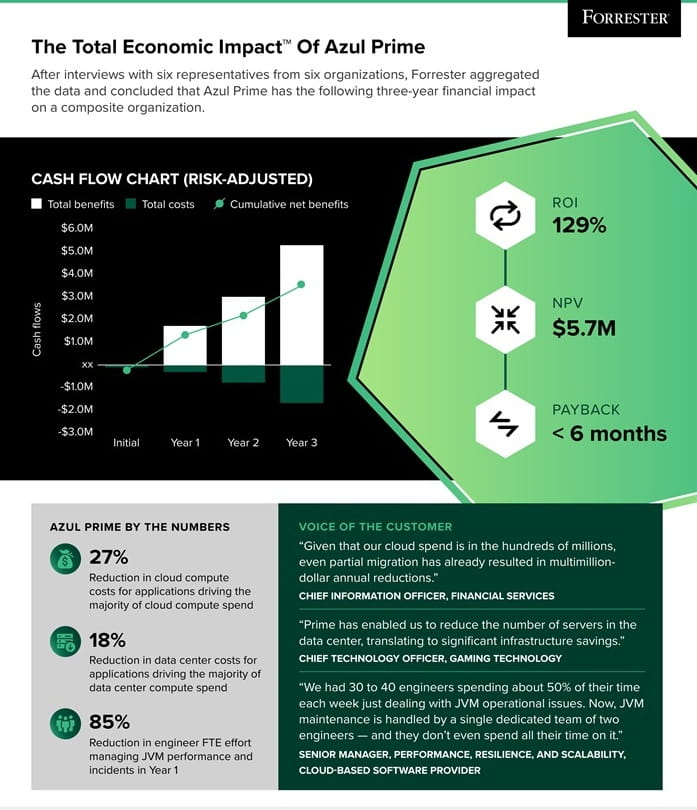
SINGAPORE, March 12, 2026 — Organisations deploying the Java platform Azul Prime achieved a 129% return on investment (ROI) and $5.7 million in net present value over three years, according to a new Total Economic Impact study conducted by Forrester Consulting.
The study, commissioned by Azul, examined the economic impact of its high-performance Java platform by interviewing six organisations that use the technology in production environments. Forrester consolidated the results into a composite enterprise running 550 Java applications, with 80 percent hosted in the cloud and 20 percent on-premises, supported by a large developer workforce and dedicated JVM performance engineers.
According to the analysis, the composite organisation realised $10.2 million in risk-adjusted benefits over three years compared with $4.4 million in costs, resulting in a payback period of less than six months.
Cloud cost savings drive the business case
A significant portion of the financial benefits came from improvements in Java performance that reduced the infrastructure required to run enterprise workloads.
The study found that organisations using Azul Prime were able to run applications more efficiently, lowering CPU utilisation and reducing latency spikes. This allowed enterprises to process the same workloads using fewer compute instances, which directly lowered cloud and infrastructure costs.
Across the organisations studied, cloud cost reductions ranged from 7 percent to as high as 50 percent, depending on the application environment and workload type.
For the composite organisation analysed by Forrester, this translated into nearly $4 million in cloud compute savings over three years, along with an additional $523,000 in on-premises infrastructure savings resulting from reduced server requirements.
One interviewee from a financial services organisation noted that the improved stability of the Java platform reduced the need to maintain large buffers of spare computing capacity.
“We used to reserve roughly 20 percent to 30 percent of CPU capacity to guard against unpredictable JVM behaviour. That extra buffer was necessary just to be safe. But with the move to Azul Prime, we’ve been able to cut a lot of that reserved CPU capacity,” the chief information officer of the financial services firm said.
Performance stability improves engineering productivity
Beyond infrastructure savings, the study also highlighted significant gains in engineering productivity resulting from more stable and predictable Java runtime performance.
Before implementing Azul Prime, performance engineers in many organisations spent considerable time troubleshooting JVM-related issues such as garbage collection disruptions, performance volatility and runtime tuning.
After adopting Azul Prime, the study found that engineering teams were able to redirect substantial time and resources toward higher-value activities.
For the composite organisation, these efficiency improvements generated an estimated $5.7 million in productivity gains, primarily through the redeployment of performance engineering staff to innovation and development work.
One technology leader interviewed for the study described a dramatic reduction in operational workload.
“We had 30 to 40 engineers spending about half their time each week dealing with JVM operational issues,” said a senior manager responsible for performance, resilience and scalability at a cloud software provider. “Now JVM maintenance is handled by a small dedicated team, and just two engineers manage JVM issues across all services.”
The Forrester study also identified several additional benefits reported by customers that were not included in the financial model.
These included faster application performance, improved customer experience due to lower latency, and more predictable system behaviour during peak workloads.
Some organisations also reported potential licensing cost savings when migrating from other paid Java development kits to Azul Prime and Azul Core.
Scott Sellers, co-founder and chief executive officer of Azul, said the findings underscore the importance of optimising Java performance as organisations scale cloud and AI workloads.
“We believe this independent study by Forrester validates what our customers are consistently telling us about their production environments. Improving Java performance is one of the most effective and often overlooked ways to reduce cloud costs at scale,” Sellers said.
He added that by improving Java Virtual Machine efficiency, enterprises can reduce infrastructure and cloud spending while allowing engineering teams to focus on innovation rather than runtime troubleshooting.
Java optimisation gaining relevance in AI and cloud-first architectures
As enterprises continue to modernise application stacks and migrate workloads to the cloud, the performance of core runtime platforms such as Java is increasingly influencing operational costs.
Java remains one of the most widely used programming environments for enterprise applications, particularly in sectors such as finance, telecommunications and cloud services.
With organisations deploying hundreds of Java-based services across distributed infrastructure, improvements in runtime efficiency can have a substantial impact on infrastructure utilisation and overall cloud expenditure.
The study suggests that optimising Java runtime performance could play an increasingly important role in helping enterprises manage the rising cost of cloud infrastructure while maintaining application performance at scale.