

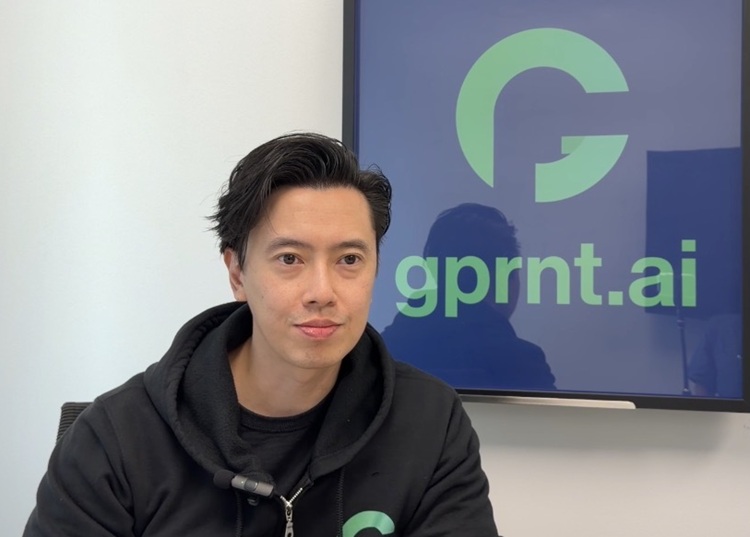
SINGAPORE, December 5, 2025 – Gprnt (‘Greenprint’), Singapore’s nationwide utility for sustainability reporting, is accelerating its mission to make Scope 1 and Scope 2 emissions reporting simple, accessible and cost-effective for every business in the country — especially small and medium-sized enterprises (SMEs).
Speaking with CarbonWire, CEO Lionel Wong described the platform’s ambition in direct and unequivocal terms, “We think that it is everybody’s God-given right to be able to generate their Scope 1 and Scope 2 emissions,” he said. “It shouldn’t cost you several thousand dollars just to process your own data into your own emissions output.”
From MAS Experiment to National Infrastructure
Gprnt began as a project inside the Monetary Authority of Singapore (MAS), designed to use technology to close critical sustainability data gaps. Over the years, the project sprang forth collaborations such as the SGX ESGenome sustainability reporting portal and the ESGpedia-powered green data registry.
By 2023, MAS leadership decided to consolidate these scattered pilots into a single platform that could scale nationally and regionally. “The decision was taken to spin it up, consolidate it, and bring everything together,” Wong said. “That led to the birth of Gprnt as it is today.”
Wong, who previously helped deliver world-first innovations such as the PayNow–PromptPay cross-border linkage, was tasked with leading the new entity.
“Baseline Reporting Should Not Be a Luxury”
Gprnt’s focus is intentionally narrow but foundational: to help all businesses automatically compute Scope 1 and Scope 2 emissions using their existing digital data trails — utility bills, invoices, fuel consumption records, and more.
“Singapore has invested heavily in digital infrastructure,” Wong explained. “All these resources already exist online. It’s your data. We’re simply translating what already exists into the emissions output every business should have access to.”
He stressed that the goal is not to replace sustainability consultants or full-scale reporting frameworks, but to democratise the starting point. “You need Scope 1 and 2 just to be in the game of sustainability,” he said.
For SMEs, the Barriers Are Real — Money, Skills, Time
SMEs form the backbone of Singapore’s economy, and their emissions are deeply intertwined with the Scope 3 requirements of large corporates. Yet, the recently launched SME Sustainability Barometer, developed by Gprnt with PwC, SBF and the Sustainability Alliance, highlights persistent adoption challenges.
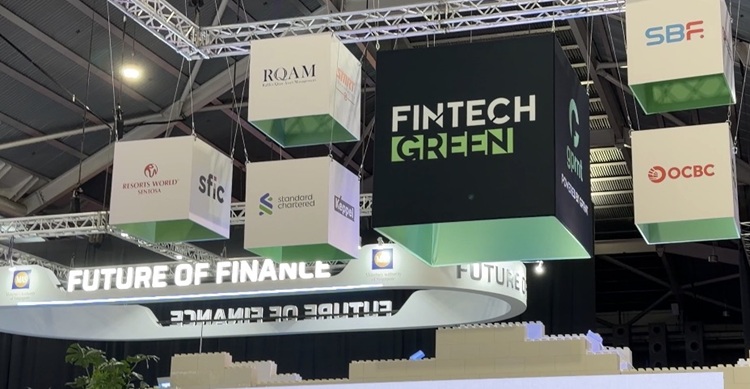
Fintech Green pavilion at SFF 2025
“SMEs continue to be besieged by money, skills and time constraints,” Wong noted. “Even though grants and initiatives exist, adoption remains alarmingly low.”
He was candid about the contradiction policymakers often face. “Just because a grant exists doesn’t mean people will reach out and grab it,” he said. “A grant helps you start — but year two, year three, year four, the costs are still there.”
This is why Gprnt prioritises zero-to-low-cost reporting, built directly on top of government-integrated digital systems.
Queen Bees: The Most Powerful Lever for SME Adoption
A key theme in Wong’s thinking is the influence of “Queen Bees” — large corporates, government agencies, and financial institutions that can shape SME behaviour through procurement and financing.
“Any large organisation with an SME network and some level of incentive power can be considered a Queen Bee,” he explained. “By virtue of that influence, they can motivate SMEs to get started on sustainability or stay engaged.”
Procurement refresh cycles and green tender specifications are powerful signals, he observed. “It’s not about excluding anyone,” Wong clarified. “If you have done something on sustainability, we want Queen Bees to recognise you for it. Small signals like that help an SME say: there is value for me, beyond just cost and compliance.”
Banks, too, are emerging as key shapers — especially through sustainability-linked loans. “Local banks have SME clientele, and if banks say: ‘We will give you a better rate if you’re committed to sustainability,’ that clearly incentivises SMEs,” he said.
Nine Recommendations — And a Push for Change by 2026
The SME Sustainability Barometer sets out nine recommendations, ranging from bulk-tender cost consolidation to green procurement frameworks. But their implementation cannot rely solely on Gprnt.
“No one actor in the ecosystem can do it alone,” Wong emphasised. “We’ve agreed with SBF and the Sustainability Alliance to examine which recommendations can be implemented next year, and who from the wider ecosystem needs to come in for each one.”
While low-hanging fixes can begin in 2026, higher-order structural shifts will take longer. However, Wong hinted at a bigger effort currently being shaped.
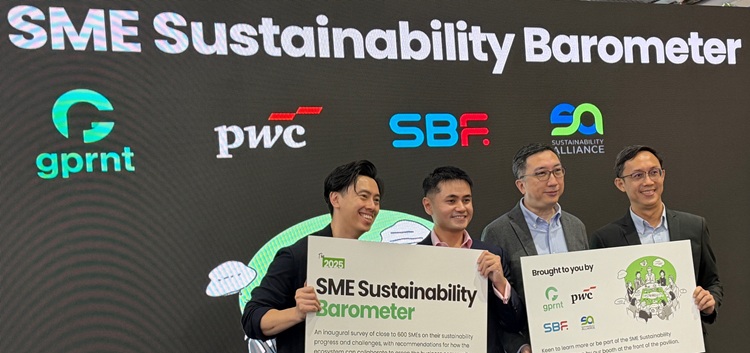
SME Sustainability Barometer launch at SFF 2025
“We do hope to see some form of wider campaign or initiative being spun up next year,” he remarked. “If we take too long, 2026 passes, then 2027 — and each time we’re a year closer to 2030. Things need to start earlier rather than later.”
Talent Remains Tight — But Not a Dealbreaker
When asked whether Singapore has enough sustainability talent to support growing demand, Wong was realistic: “Hiring someone with sustainability expertise used to come at a premium — and I think it still does,” he said.
But he also pointed to strong upskilling pipelines: university programmes, mid-career transition schemes, and the practicality of SMEs designating internal staff to double-hat sustainability roles.
“We are learning to grow our own trees,” he said. “Given time, more professionals will be equipped through different pathways.”
And if tools get better, he added with a smile, SMEs may turn to digital helpers. “Failing which, you will go to the same well that everybody drinks from now — ChatGPT and other generative AI tools.”
Asia, Not Europe, Will Shape the Next Sustainability Wave
While Europe once inspired early Gprnt thinking — particularly the idea of a regionwide Single Access Portal — Wong believes the future lies closer to home.
“We look at Asia, and specifically ASEAN, as the region of growth,” he said. “This region will be an engine of change on the global agenda.”
He cites digital literacy, demographic youthfulness, biodiversity richness and climate risk exposure as reasons why Asia will lead the next phase of sustainability adoption.
Meanwhile, Europe faces political resistance and regulatory fatigue, and the US is sending “unclear signals” — a polite understatement, he noted.
“There’s a lot of clarity about what the current administration’s views are,” he said with careful phrasing, “but that’s not necessarily shared by everyone in the States — which is why you have this phenomenon called greenhushing.”
“You Cannot Leave It Too Late” — Why SMEs Must Start Now
Ultimately, Wong’s message to SMEs is both pragmatic and urgent: start with Scope 1 and Scope 2 now. “Even if we launch something tomorrow, it takes time for things to take root,” he warned. “Adoption needs time to reach a tipping point. You cannot leave it too late.”
And as Singapore moves steadily toward its 2030 Green Plan milestones, baseline reporting will shift from advantage to expectation. “We want to help SMEs get started,” he said, “but we’re greedy — we want to help them go much further.”