
LAS VEGAS, January 7, 2026 – As CES 2026 moved into full stride on January 7, the world’s largest technology showcase made one thing abundantly clear: the convergence of artificial intelligence, robotics, and physical systems is no longer theoretical — it is unfolding at scale and speed.
Across the sprawling show floor and conference venues, the mood was unmistakably confident, forward-leaning, and at times disruptive. From consumer electronics to heavy industry, from entertainment to enterprise, the technologies on display pointed to a future where AI is not just embedded in products, but deeply woven into how entire sectors operate.
AI Everywhere: From Software to the Physical World
Artificial intelligence remained the defining thread across CES on January 7, but with a notable shift in emphasis. Conversations and demonstrations moved beyond generative AI as a novelty, focusing instead on applied, embedded, and domain-specific AI.
Panels and exhibits showcased how AI is now being integrated into:
- Manufacturing systems, enabling predictive maintenance, adaptive production lines, and real-time quality control
- Media and entertainment, where AI is reshaping content creation, post-production workflows, and personalised audience engagement
- Healthcare and wellness, with AI-driven diagnostics, assistive technologies, and personalised care models
- Enterprise and industrial operations, where AI is powering decision intelligence, automation, and energy optimisation

The clear takeaway from January 7 was that AI is fast becoming invisible infrastructure — embedded into hardware, processes, and platforms rather than existing as a standalone layer.
Robotics Take Centre Stage
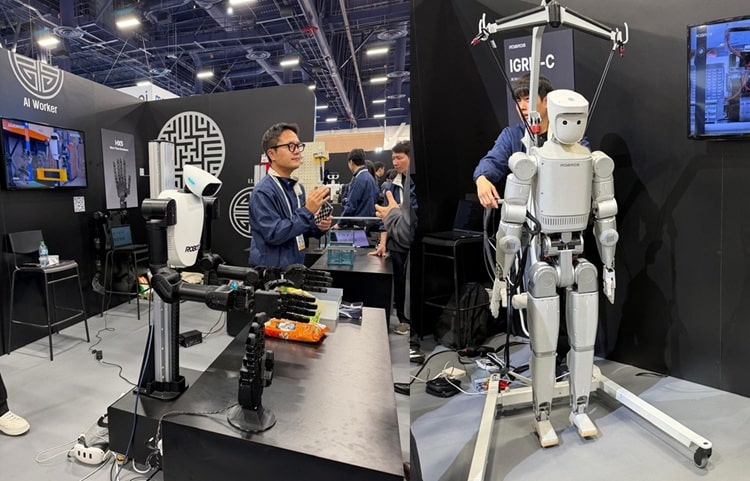
If AI provided the intelligence, robotics gave CES 2026 its most tangible and visually arresting moments.
Robots of every form factor dominated attention — from humanoid concepts and collaborative industrial robots to autonomous service machines designed for logistics, retail, hospitality, and healthcare. What stood out this year was not just the diversity of robots, but the maturity of their capabilities.
Exhibitors highlighted:
- Human-centric design, focusing on safety, adaptability, and natural interaction
- AI-enabled perception and mobility, allowing robots to operate in complex, real-world environments
- Scalable deployment models, signalling readiness for commercial and industrial adoption
The narrative around robotics has clearly shifted from experimentation to practical deployment, reinforcing the idea that physical AI will be one of the most consequential technology trends of this decade.
Industry Boundaries Continue to Blur
One of the strongest undercurrents on January 7 was the collapse of traditional industry silos.
Manufacturing companies spoke the language of software and data. Media and entertainment firms discussed automation, AI agents, and synthetic content. Automotive and mobility players framed themselves as technology platforms rather than vehicle manufacturers.
CES increasingly resembles a cross-sector convergence forum, where technology is no longer an enabler of industries but the common foundation across them. The implication is profound: no sector can assume immunity from disruption.
Startups, Scale-ups and the Next Wave
At Eureka Park and across national pavilions, startups and scale-ups added a vital layer of energy and experimentation to the day’s proceedings.
Many young companies showcased:
- AI-native products built specifically for vertical markets
- Climate- and sustainability-aligned innovations, particularly in energy efficiency, materials, and industrial optimisation
- Hardware-software convergence, reflecting falling barriers between physical and digital innovation
For investors, partners, and policymakers, January 7 reinforced CES’s role as an early indicator of where capital, talent, and attention are likely to flow next.
The Bigger Message from CES 2026
Beyond individual product launches and demonstrations, the broader message from CES on January 7 was unmistakable.
The pace of technological change is accelerating unevenly. For some sectors and organisations, the transition will be gradual. For others, it will arrive as a sudden and overwhelming shift. But no industry will be untouched.
CES 2026 is not merely showcasing future technologies — it is issuing a strategic warning and an invitation at the same time: adapt early, adapt decisively, or risk irrelevance.
As the show continues, CES is reaffirming its role not just as a technology exhibition, but as a global barometer of how AI-driven change will reshape economies, industries, and societies in the years ahead.