
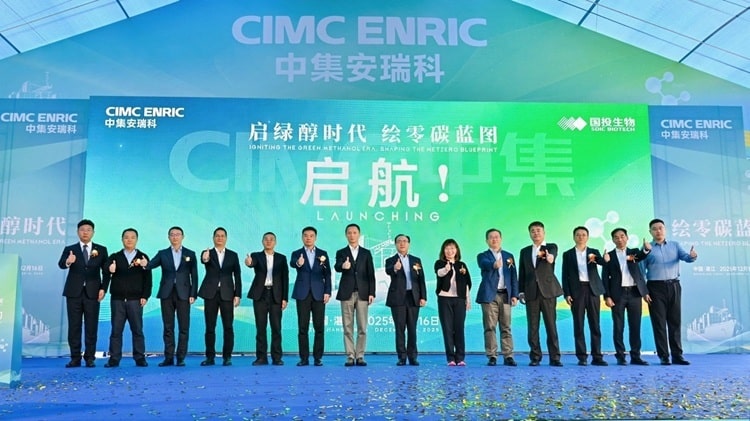
HONG KONG / ZHANJIANG, China, December 17, 2025 — CIMC Enric Holdings Limited has commissioned China’s first large-scale bio-based green methanol project in Zhanjiang, Guangdong Province, marking a significant milestone in the country’s clean energy and maritime fuel transition.
Developed by CIMC Enric and its subsidiaries, the project was officially commissioned on December 16 in the presence of senior government officials, industry leaders and global maritime partners. Attendees included CIMC Group President Gao Xiang, CIMC Enric Executive Director and President Yang Xiaohu, senior representatives from SDIC Bio-Energy, and officials from the Zhanjiang Municipal Government, alongside international shipping and fuel industry stakeholders.
With an initial annual production capacity of 50,000 tonnes, the facility is China’s first commercially scaled bio-based green methanol plant and represents CIMC Enric’s strategic expansion beyond hydrogen energy into clean liquid fuels for the global shipping sector.
Positioning Green Methanol as a Viable Maritime Fuel
Global shipping accounts for around 3 per cent of total global carbon emissions, and the International Maritime Organization (IMO) has set a target for the sector to achieve net-zero emissions by 2050. Green methanol is increasingly viewed as one of the most practical alternative fuels capable of meeting near-term decarbonisation requirements while remaining compatible with existing maritime infrastructure.
The Zhanjiang project has been designed as a fully integrated closed-loop value chain, spanning biomass residue sourcing, green methanol production, storage, transport and marine bunkering. According to CIMC Enric, the project achieves an over 83 per cent reduction in lifecycle greenhouse gas emissions, with the entire value chain certified under the ISCC EU sustainability certification scheme. Carbon traceability has also been independently verified through C-14 testing by Beta Analytic in the United States.
The facility aligns with key international regulatory frameworks, including the IMO 2050 Net-Zero Target, the EU Carbon Border Adjustment Mechanism (CBAM) and the EU Renewable Energy Directive (RED), positioning it to serve both domestic and international shipping markets.
Strategic Location and Export Potential
Located at the southern tip of mainland China, Zhanjiang offers abundant agroforestry residues and direct access to deepwater port infrastructure. The project leverages proprietary biomass gasification technologies to convert agricultural and forestry waste into high-value clean fuel, supporting both rural economic development and China’s broader “Dual Carbon” goals.
Backed by 30,000 cubic metres of on-site methanol storage and a dedicated loading berth at Zhanjiang Deepwater Port, the facility enables a streamlined one-hour production-to-shipment cycle. CIMC Enric has also established a same-day delivery bunkering network covering the Greater Bay Area, reducing transport emissions and improving supply efficiency.
From Zhanjiang, green methanol will be supplied to key domestic and international markets, including Hong Kong, Singapore and major regional ports, strengthening South China’s role in the emerging global green shipping ecosystem.
Industry Collaboration and Market Momentum
The commissioning ceremony drew participation from major global maritime and energy players, including Maersk, CMA CGM, BASF, China Marine Bunker (PetroChina) and Sinopec Fuel Oil Sales. Industry experts from Argus Media and Bunker Holding also addressed the growing demand for bio-based green methanol as a marine fuel.
Speaking at the event, CIMC Group President Gao Xiang said the Zhanjiang facility signalled the emergence of South China as a new hub for green shipping and clean fuel innovation. He noted that CIMC Enric aims to work closely with upstream and downstream partners to accelerate the commercial adoption of low-carbon fuels across global shipping routes.
With this project, CIMC Enric adds a new pillar to its clean energy portfolio, reinforcing its ambition to play a leading role in the industrialisation and global deployment of green methanol as a next-generation marine fuel.